Active travel case studies
These case studies illustrate how investment in active travel significantly benefits communities.
City of Edinburgh
The City of Edinburgh Council is improving streets in the Gorgie–Dalry area to support walking, wheeling and cycling, as part of the wider Dalry Town Centre programme funded through Places for Everyone and Transport Scotland’s Active Travel Infrastructure Fund (ATIF).
Working with the Council’s Capital Maintenance team, the project aligned with planned resurfacing on four side streets to deliver early improvements from the wider scheme.
Five continuous footways and three raised tables were introduced, improving pedestrian priority, encouraging lower vehicle speeds and making the streets safer and more accessible. Changes also improved access to the Telfer Subway, a key local walking and cycling route.
A new continuous footway construction detail was developed in response to earlier quality concerns and agreed with Roads and Road Maintenance teams. This has now been successfully delivered and will support higher-quality schemes across the city.
Coordinating active travel improvements with maintenance works reduced costs, minimised disruption and accelerated delivery.
Key Outcomes
- Safer, more accessible streets for walking and wheeling
- Improved access to the Telfer Subway
- Five continuous footways and three raised tables delivered
- New approved construction standard for continuous footways
- Improved value for money through coordinated delivery
Total cost: £340,000 (ATIF Tier 1 and Tier 2)


East Dunbartonshire
East Dunbartonshire Council upgraded Canniesburn Toll roundabout to improve safety and accessibility for all road users, following increased traffic demand linked to new developments in Bearsden and nearby Milngavie.
Previously, the junction carried moderate to heavy traffic and was not suitable for walking, wheeling or cycling. The project reconfigured the roundabout to better accommodate different users while improving overall operation.
Works included the introduction of traffic signals, new pedestrian crossings and shared-use footways, alongside upgrades to drainage, street lighting, parking provision and carriageway surfacing.
The improvements have made the junction safer and easier to navigate, particularly for pedestrians and cyclists, while maintaining traffic flow on a key part of the local road network.
Post-completion monitoring (September 2025) showed reduced vehicle speeds, increased pedestrian movements and improved user behaviour across the junction.
Key Outcomes
- Safer, signal-controlled junction for all users
- Improved provision for walking, wheeling and cycling
- Reduced vehicle speeds
- Increased pedestrian activity
- Better overall junction operation
The total project cost was £2.34 million, funded through a combination of developer contributions, the Council’s capital programme and £382,587 from Transport Scotland’s Active Travel Infrastructure Fund (ATIF) Tier 1.


Falkirk
Falkirk Council is delivering a new active travel route between Denny and the Falkirk Wheel, creating a key link to the canal towpath network and National Cycle Network.
The full project will transform an existing railway corridor into a high-quality, off-road shared-use route for walking, wheeling and cycling, improving connections between communities and key destinations.
Phase 1 delivered 1.1km of upgraded path between Denny High School / Denny Eastern Access Road and Chacefield Woods. The route was widened to 3 metres and resurfaced in tarmac, with new kerbing and street lighting to improve accessibility, safety and usability year-round.
This is the first stage of a larger project that will include three new bridges, including a crossing over the M876, further enhancing connectivity across the area.
The improved route provides a safer, more attractive alternative to road travel, supporting everyday journeys as well as leisure trips.
Key Outcomes
- 1.1km of new and upgraded shared-use path
- Safer, wider route for walking, wheeling and cycling
- Improved links between Denny and the Falkirk Wheel
- Connection to the canal towpath and National Cycle Network
- First phase of a strategic active travel corridor
Phase 1 received £710,500 from Transport Scotland’s Active Travel Infrastructure Fund (ATIF) Tier 1. Further phases are planned for construction in 2026/27.


Highland
Highland Council introduced a package of measures around Smithton Primary School to improve road safety and support active travel, following concerns from parents and the school about congestion, parking and vehicle behaviour at drop-off and pick-up times.
Initial improvements focused on extending an existing raised table, upgrading pedestrian crossing points and refreshing road markings to reinforce parking restrictions. These measures helped reduce vehicle speeds and improve driver behaviour outside the school.
Following further engagement with the Parent Council, school representatives and an Elected Member, additional measures were developed to strengthen the scheme. A zebra crossing on Murray Road was upgraded to a puffin crossing, alongside the introduction of high-friction surfacing to improve safety and reduce braking distances.
The improvements support a ‘park and stride’ approach, encouraging families to park nearby and walk the final part of the journey to school, helping to reduce congestion at the school gate.
Feedback from the school community has been positive, with reported reductions in inappropriate parking and increased confidence in children travelling safely to and from school.
Key Outcomes
- Safer school environment with reduced vehicle speeds
- Improved pedestrian crossings, including a new puffin crossing
- Reduced congestion and inappropriate parking at peak times
- Increased confidence in walking and wheeling to school
- Support for ‘park and stride’ journeys
The project was funded through Transport Scotland’s Active Travel Infrastructure Fund (ATIF) Tier 1, with a total cost of approximately £125,000.


Midlothian
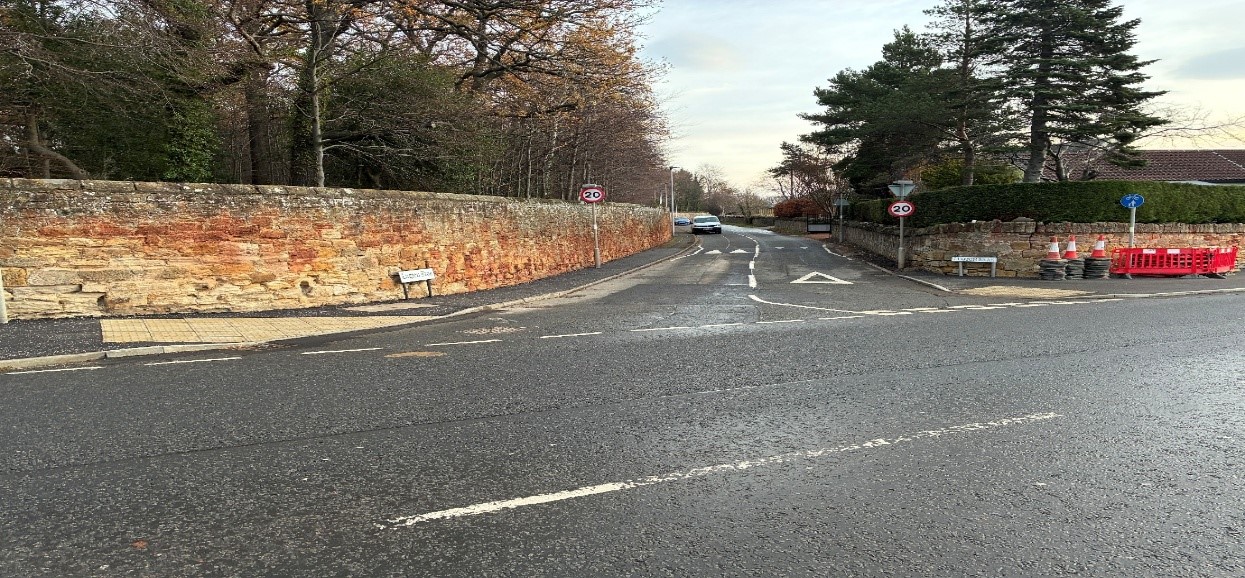
Through the Council’s Active Travel Strategy, residential feedback and from residents’ correspondence, concerns were raised by residents crossing safely at this location, particularly in relation to poor visibility and limited priority for cyclists. This route is a well-used cycle corridor providing access to Dalkeith Country Park and serves as one of the principal gateways into the town of Dalkeith.
Following a site assessment carried out in partnership with colleagues from the Roads and Sustainable Transport teams, it was agreed that improvements to the junction layout would enhance safety and accessibility for all users. The scheme focused on narrowing the junction to shorten the crossing distances, improve visibility, and create a safer environment for pedestrians and cyclists.
The completed improvements have been positively received by residents and users of the route, with feedback highlighting the enhanced visibility and ease of navigation at the junction.
An example of resident feedback is provided below: -
Further to our correspondence about the Lugton Brae top junction, I am writing to thank you – the visibility is hugely improved and it’s much easier to navigate!
The cost of this project was £15,925 from Tier 1.

North Ayrshire
North Ayrshire Council has successfully utilised Scottish Government Active Travel Infrastructure Tier 1 funding to upgrade a series of footpaths within Kilbirnie Park -approx. 580m in length. This project involved widening the existing footpaths shown in plan from 2m to 3m. Filter drains were also installed to improve drainage.
Existing paths within the park were 2m wide with useable width less than that due to grass encroachment. Upgrading footpaths to 3m make them accessible as shared use paths for walking, cycling and wheeling. The footpaths connect with Ladysmith Road, Hagthorn Avenue, Mossend Avenue, Fudstone Drive, Kilbirnie Library and Gowanlea Day Care Centre. The footpath works coupled with drainage improvements make sustainable travel within the local community more appealing.
This project was funded exclusively with Active Travel Infrastructure Tier 1 funding and cost £211,775.42


Perth and Kinross
Perth and Kinross Council improved pedestrian access along Castle Brae, a narrow rural road linking Ruthvenfield to the A85, where a missing footway had previously prevented safe walking and wheeling.
The route connects local housing to the primary school, nearby shops and public transport links. However, a 360m section without footway required pedestrians to use the carriageway, limiting access and preventing children from walking to school.
Building on earlier works to deliver sections of footway closer to the A85, the 2025/26 project completed the remaining gap through the narrowest part of the road. Space constraints from boundary walls and embankments required a revised layout, including narrowing the carriageway and introducing a one-way system.
A new 1.5m footway was installed alongside upgraded street lighting, improving visibility and safety along the route.
The completed scheme now provides a continuous pedestrian connection between Ruthvenfield and key local destinations, enabling safer everyday journeys and reducing reliance on short car trips.
Key Outcomes
- New continuous footway linking housing to the local primary school
- Safer access to the A85, including shops and public transport
- Reduced need for school transport for short journeys
- Improved safety on a previously inaccessible rural road
- Enhanced lighting along a previously unlit section
The project was delivered through a phased approach, with the final section completed in 2025/26.

