Crossings
Principles
Safe and effective crossings are essential where facilities for cycle users and pedestrians and roads interact.
This chapter sets out guidance to be applied at crossing points where different user groups interact and provides examples of how this guidance can be applied at typical layouts.
The Scottish Government’s Sustainable Travel Hierarchy sets out guiding principles which should be recognised when designing crossings. Consideration of those most at risk is vital. Cycle users are potentially vulnerable when interacting with motor traffic. Similarly, where cycle users and pedestrians interact, the pedestrian requires careful consideration to facilitate crossing. Understanding potential and latent demand, and how this may impact on future volume of all users, is key to developing appropriate crossing facilities.
The core principles outlined in Chapter 2, of safety, directness, comfort, attractiveness, coherence and adaptability, should be used to guide design decisions where crossings are required. Understanding the success criteria that will achieve these objectives, and applying these to designs, is critical.
Success criteria include the following:
- Maximising motor vehicle driver concentration
- Minimising the interaction between cycle users and motor traffic and pedestrians
- Providing suitable visibility at crossings, facilitated by suitable angles of approach
- Minimising the speed differential between cycle users and motor traffic, and cycle users and pedestrians, by the design of the approaching layout
- Maximising cycle users’ concentration by removing/minimising extraneous obstacles such as chicanes, bollards and signs
- Reducing probability of cycle users having to stop, wait and regain momentum, particularly by crossings being blocked
- Enabling cycle users to follow the most direct and logical route
- Maximising natural surveillance and user visibility
- Providing a coherent approach to crossings and junctions along a cycle route.
Providing appropriate facilities
Crossings should provide safe passage for all users and this is achieved by managing the interactions between user groups. Solutions should be appropriate to the circumstances of the site and the behaviour and demands of the users. This is essential to conform to the core design principles.
Crossing types
Where a crossing is required, either between pedestrians and cycle users, or cycle users and motor traffic (or a combination of both), there are four broadly defined methods of managing the interactions:
- Controlled crossings (without signals) – such as Parallel and Zebra crossings
- Uncontrolled crossings – either completely uncontrolled, or arranged in a layout where users on one facility are required to give way to those on another facility
- Signal controlled crossings and junctions incorporating phases for cycle users
- Grade separation – where facilities are completely separated by overbridges or underbridges.
This chapter sets out key individual components of the design at crossing locations and outlines a variety of layouts which can be applied.
Developing appropriate solutions
Selecting the most appropriate form of crossing requires careful assessment. For cycle users and pedestrians, safety, directness and comfort are paramount. Managing the interactions at crossings is key to enabling those most at risk to navigate independently.
The design process depends on the resolution of site-specific factors. It is not necessarily the case that the greatest level of control will be the best solution. Overprovision in the wrong situations can be problematic. For example, signal control where it is not justified by demand can lead to excessive and unnecessary delays and frustration for all users. Therefore, balance and local factors strongly influence decisions.
| Clause Number | Description |
|---|---|
| 4.2.1 | An initial site assessment should be carried out by an experienced practitioner to ensure factors relating to the site are incorporated in the design process. |
A site-specific assessment will consider factors that may include:
- Pedestrian and cycle user volume and composition
- Motor traffic volume and composition
- The context of the interaction within a junction or multi-modal crossing
- Speed of motor traffic
- Injury accident record
- Street geometry and other geometric controls
- Adjacent physical constraints
- Coherence with other crossings on the route
- Feedback from public consultation, including groups representing disabled people.
Cycle user and pedestrian interactions – key considerations
In general terms, a higher volume of pedestrians and cycle users will require a greater degree of control, subject to other site-specific factors. Formal control measures such as Zebra crossings become more appropriate with higher user numbers, enabling pedestrians to cross the cycle facility safely.
Signal-control is unlikely to be necessary to address simple interactions between cycle users and pedestrians, unless volume is particularly high. However, signal control might be incorporated into more complex arrangements, such as where cycle users and pedestrians interact in the context of a road junction.
Consistent management of cycle user and pedestrian interactions along a route or within a local area allows those most at risk to become familiar with the layout and with the behaviours of other users.
Where cycle routes intersect they are unlikely to justify signal control. As the mode is the same on both routes there is also no requirement for other control measures such as a Zebra crossing. Therefore, these interactions will generally be uncontrolled. This may provide priority to one dominant route through a give-way arrangement, or alternatively give no formal priority to either route.
Road crossings – key considerations
The most appropriate way to manage a road crossing will depend on various site-specific factors, and a key consideration is the speed of motor traffic.
Table 4.1 provides a preliminary guide to suitable road crossing types based on motor traffic speeds. It illustrates that as the speed of motor traffic increases, and the degree of control applied to motor traffic reduces, the safety of users crossing the road is less certain and the crossing generally becomes less attractive to cycle users, particularly to those who are less experienced or less confident.
There are defined maximum speeds at which controlled Parallel and Zebra and signal-controlled crossings may be provided. However, while there are no defined thresholds regarding the provision of uncontrolled crossings, the level of service can reduce significantly where motor traffic speeds are higher.
Grade separation provides the greatest protection to cycle users crossing roads, particularly on higher speed roads. It is unlikely to be justified environmentally or economically at low traffic speeds, or low traffic volumes. Where grade separation is provided, the directness of the route for cycle users and pedestrians should be maintained as far as possible.
| Clause Number | Description |
|---|---|
| 4.2.2 | Parallel and Zebra crossings should not be installed on roads with an 85th percentile speed of 35 mph (56 kph) or above without speed reducing measures to slow traffic, in accordance with Traffic Signs Manual Chapter 6. |
| 4.2.3 | Stand-alone signal-controlled crossings should not be provided where the 85th percentile speed of motor traffic is greater than 80 kph. |
| Motor traffic speed (85th percentile) | Uncontrolled | Controlled Zebra or parallel | Signal-controlled | Grade separated |
|---|---|---|---|---|
| 0 to 30 kph | Medium | High | High | High |
| 30 to 55 kph | Low | Medium | High | High |
| 55 to 80 kph | Low | Should not be used | High | High |
| More than 80 kph | Low | Should not be used | Should not be used | High |
Design components
There are various components which are common to several crossing layouts. These include visibility requirements and the treatment of waiting areas adjacent to crossings. These are discussed in this section.
Visibility envelope
Visibility is an essential factor in ensuring safety where facilities intersect.
At Zebra and Parallel crossings, and at uncontrolled crossings where priority is assigned to a ‘through route’ over an ‘adjoining route’, the principle of a visibility envelope is applied. Adequate visibility is ensured by the provision of such an envelope. This is illustrated in Figure 4.1.

The visibility envelope defines an eye point on the adjoining route or facility, which is set a perpendicular distance (X) from the through route. From this point, users have to be able to see the full width of the through route (including the cycle track and the road as required), for an appropriate distance (Y). Where the through route is two-way this has to be provided in both directions. Otherwise it is only required in the direction of approaching traffic.
The required distances and heights are dependent on the type of facility. The eye height and X distances for pedestrian and cycle facilities and roads are detailed in Table 4.2. Pedestrian X distances are based on the requirements of wheelchair users (and their assistants), mobility scooters and pram users.
The associated target height and Y distances are detailed in Table 4.3. The speed used to define the Y distance is:
- The design speed, where the through route is a cycle track or a new road
- The 85th percentile motor vehicle speed, where the through route is an existing road.
The visibility envelope as described does not apply to signal-controlled junctions, or to uncontrolled conflict points which assign no priority. Requirements at these locations are discussed in the relevant sections.
| Location | Eye height range | Desirable minimum X | Desirable maximum X |
|---|---|---|---|
| Pedestrian facility | 0.9 to 2.0 m | 1.5 m | 1.5 m |
| Cycle or shared facility | 0.8 to 2.2 m | 4.0 m | 2.0 m |
| Road | 1.05 to 2.0 m | 4.5 m | 2.4 m |
| Location | Target height range (m) | Design (85th percentile) speed 120 kph | Design (85th percentile) speed 100 kph | Design (85th percentile) speed 85 kph | Design (85th percentile) speed 70 kph | Design (85th percentile) speed 60 kph | Design (85th percentile) speed 50 kph | Design (85th percentile) speed 40 kph | Design (85th percentile) speed 30 kph | Design (85th percentile) speed 20 kph |
|---|---|---|---|---|---|---|---|---|---|---|
| Cycle facility | 0.26 to 2.0 | N.A. | N.A. | N.A. | N.A. | N.A. | N.A. | 31** | 20** | 12** |
| Road | 0.26 to 2.0 | 295* | 215* | 160* | 120* | 56** | 43** | 31** | 20** | N.A. |
| Clause Number | Description |
|---|---|
| 4.3.1 |
A visibility envelope should be provided at Zebra and Parallel crossings, and at uncontrolled interactions where an adjoining route meets a through route, in accordance with the values defined in Tables 4.2 and 4.3. Note: In retro-fit situations adjacent to visibility constraints, designers are encouraged to refer to the Design Review process outlined in Chapter 2. |
| 4.3.2 | Where the adjoining route is a cycle track, low level obstructions which would obscure the visibility from a recumbent cycle or hand cycle should be avoided in the immediate vicinity of the crossing or interaction point. |
| 4.3.3 | Where the adjoining route features give way markings, the X distance should be measured from the marking. Otherwise it should be measured from the nearside edge of the through route. |
| 4.3.4 | Where a cycle track or road forms the through route, the Y distance should be measured from the centre of the adjoining facility, as illustrated in Figure 4.1. |
| 4.3.5 | Where the through route terminates within the Y distance (e.g. at a priority junction), the visibility should be provided to the end of the through route. |
Shared use waiting areas at crossings
Where pedestrians and cycle users are required to cross a road in close proximity, shared use waiting areas allow the situation to be managed safely while not compromising the Sustainable Travel Hierarchy. A significant principle of shared use waiting areas is that all users are made aware of the changed status of the area that they are entering, so that they understand the situation and can alter their behaviour accordingly.
Where the status of a route is changing, either between a pedestrian route and a shared use waiting area, or between a designated cycle route and a shared use waiting area, tactile paving is used to indicate the change.
Cycle users require adequate visibility of the pedestrian route with which they are interacting, so that they can ensure that it is clear before entering. Where necessary, cycle speed control measures may be applied on approach to the shared use waiting area, through the horizontal alignment of the approaching cycle route and/or road markings.
At the point where pedestrians are required to cross, appropriate tactile paving is required, defined by whether the road crossing is controlled or uncontrolled. Dropped kerbs are also required at the crossing point, and appropriate visibility of the road provided. In the case of uncontrolled and Parallel crossings, the X-distance from a shared use waiting area is defined by the requirements of the cycle user.
Guidance on tactile paving and dropped kerbs is contained in Guidance on the use of Tactile Paving Surfaces and in Roads for All: Good Practice Guide for Roads respectively.
A typical shared use waiting area at a crossing point is illustrated in Figure 4.2.

| Clause Number | Description |
|---|---|
| 4.3.6 | Dropped kerbs at crossings and transitions should be 'flush' with the adjacent road or cycle route surface, with the permissible tolerance being up to 6 mm. |
Separated landing areas at crossings
While shared use waiting areas can be an effective means of managing the interaction between cycle users and pedestrians on the road edge, the provision of separate waiting areas has potential to reduce the degree of interaction and delay. A way of achieving this is by providing a “landing” area on the road edge, which is clear of any adjacent footway or cycle track. An example is illustrated in Figure 4.3.

The landing area enables cycle users and pedestrians to be positioned separately as they wait to cross the road. This is beneficial where the road crossings are also separate, such as at Parallel crossings. Interactions between the footpath and cycle track have to be managed appropriately, and the most effective method will be dependent on layout and user volume on the intersecting facilities. In the example illustrated a Zebra crossing is provided to enable pedestrians to cross the cycle track and access the landing area.
The provision of a landing area requires additional width on the roadside. In the example illustrated the combined width of the footway, the cycle track and the landing area is required. The landing area width has to accommodate any tactile paving, and to enable the design cycle vehicle to be positioned clear of the cycle track through route. Where appropriate, build-outs can help to provide the required width.
Guidance on tactile paving and dropped kerbs is contained in Guidance on the use of Tactile Paving Surfaces and in Roads for All: Good Practice Guide for Roads respectively.
It is preferable to provide consistent crossing facilities on both sides of the road. This improves clarity for users and simplifies wayfinding. However this will often be influenced by the layout of interacting facilities, and the space available. The provision of separated facilities on one side of the road may be beneficial, even where similar facilities cannot be provided on the other side.
Perpendicular approaches to crossings and junctions
Where a cycle facility approach is perpendicular to the road it needs to cross, the horizontal alignment in advance of the crossing should discourage high speeds. SLOW markings on the cycle route (to TSRGD Diagram 1058.1) may be used to warn cycle users of the interaction ahead but excessive signage and visual clutter should be avoided. Speed and access control measures such as physical barriers and bollards should only be considered as a last resort and will need to consider access for all cycle types if used.
Parallel and Zebra crossings
Parallel and zebra crossings assign a degree of control to a route, enhancing the priority of those crossing. They enable those most at risk to cross the route of larger and potentially faster vehicles, for example:
- Enabling pedestrians to cross cycle tracks
- Enabling cycle users and pedestrians to cross a road.
Parallel and Zebra crossings are easily aligned with the Sustainable Travel Hierarchy. In situations where the vehicle type on one route is larger and potentially faster, and may otherwise assume priority, the balance of priority can be redressed in favour of the users who sit higher in the Sustainable Travel Hierarchy.
These controlled crossings require care and consideration by all users. Those crossing are required to wait until it is safe to proceed. Those on the through routes should give way to those waiting and must give way to those who have proceeded to cross.
Features of a controlled crossing are likely to include:
- Zebra markings
- A parallel route for cycle users
- Physical infrastructure to accommodate crossing, such as dropped kerbs and tactile paving.
Guidance on tactile paving and dropped kerbs is contained in Guidance on the use of Tactile Paving Surfaces and in Roads for All: Good Practice Guide for Roads respectively.
Controlled crossings are relatively inexpensive to install and maintain, and likely to have a relatively low visual and environmental impact on the surrounding area. They are most likely to be suitable where traffic volumes and speed are low on the through route and where there is a demand for those most at risk to be given priority over larger vehicles.
Care is required to ensure that enough space and information is provided to all users of the crossing and that visibility for users is maximised. It may be necessary to introduce additional features to slow users approaching the crossing.
Zebra crossing of cycle track
Where cycle users and pedestrians meet, the provision of a Zebra crossing increases pedestrian priority and aligns with the Sustainable Travel Hierarchy. They are used where a pedestrian route is required to cross the cycle network. They may be standalone, included within facilities such as bus stop bypasses, or be incorporated as part of a wider junction, potentially in combination with features such as:
- A controlled crossing of the road, e.g. Zebra crossing
- A signal-controlled crossing of the road, e.g. Puffin crossing.
Suitable crossing facilities including dropped kerbs and tactile paving are required. Adequate visibility along the cycle track is required from a position within the pedestrian route where it meets the cycle route. Features to emphasise the crossing and to slow cycle users, such as speed tables, may also be incorporated, though these should not be so severe as to cause discomfort to cycle users or to reduce the accessibility of the cycle track to the full range of cycle vehicles and users.
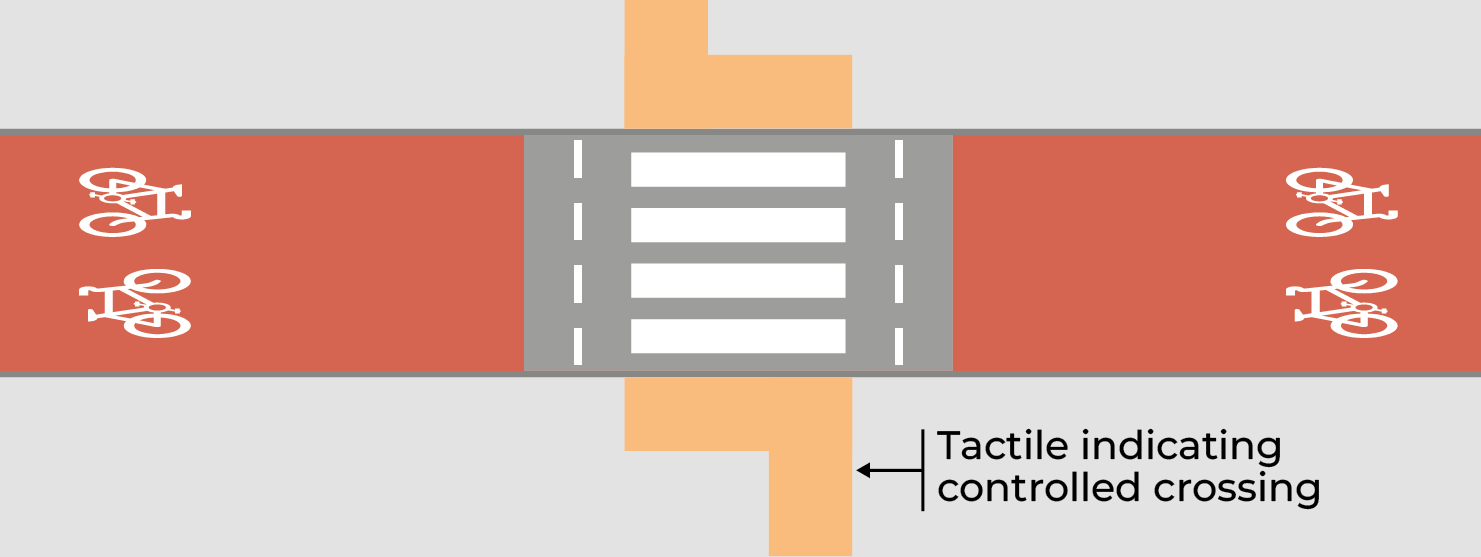
The crossing is identified by alternate black and white Zebra crossing markings aligned in the direction of the cycle route. The coloured surface of the cycle track is suspended across the crossing to emphasise it more clearly to all users. SLOW markings on the cycle track may be used to warn cycle users of the crossing ahead.
Figure 4.4 illustrates an example of a Zebra crossing for pedestrians across a two-way cycle track.
| Clause Number | Description |
|---|---|
| 4.4.1 | A visibility envelope is required in accordance with Section 4.3. |
| 4.4.2 |
Signs and markings should be in accordance with Traffic Signs Manual Chapter 6. Note: Where a Zebra crossing only crosses a cycle track, a yellow globe and zig-zag markings on approach are not required. |
| 4.4.3 | The route through the crossing, i.e. the Zebra markings, should be a minimum width of 2.4 m, and may be wider determined by the pedestrian crossing demand. |
| 4.4.4 | Dropped kerbs should be 'flush' with the cycle track, with the permissible tolerance being up to 6 mm. |
Parallel crossing
Where a cycle track meets a road, motor vehicles often dominate due to their greater speed and size, and measures may therefore be necessary to redress the balance. A Parallel crossing of the road increases pedestrian and cycle priority and aligns with the Sustainable Travel Hierarchy.
Suitable crossing facilities, including dropped kerbs and tactile paving are required. A suitable visibility envelope is required along the road for those waiting to cross the road.
Motor traffic speed on approach to the crossing should be controlled and it may be appropriate to incorporate traffic management measures such as a road hump/speed table, with a maximum ramp gradient of 1:10.
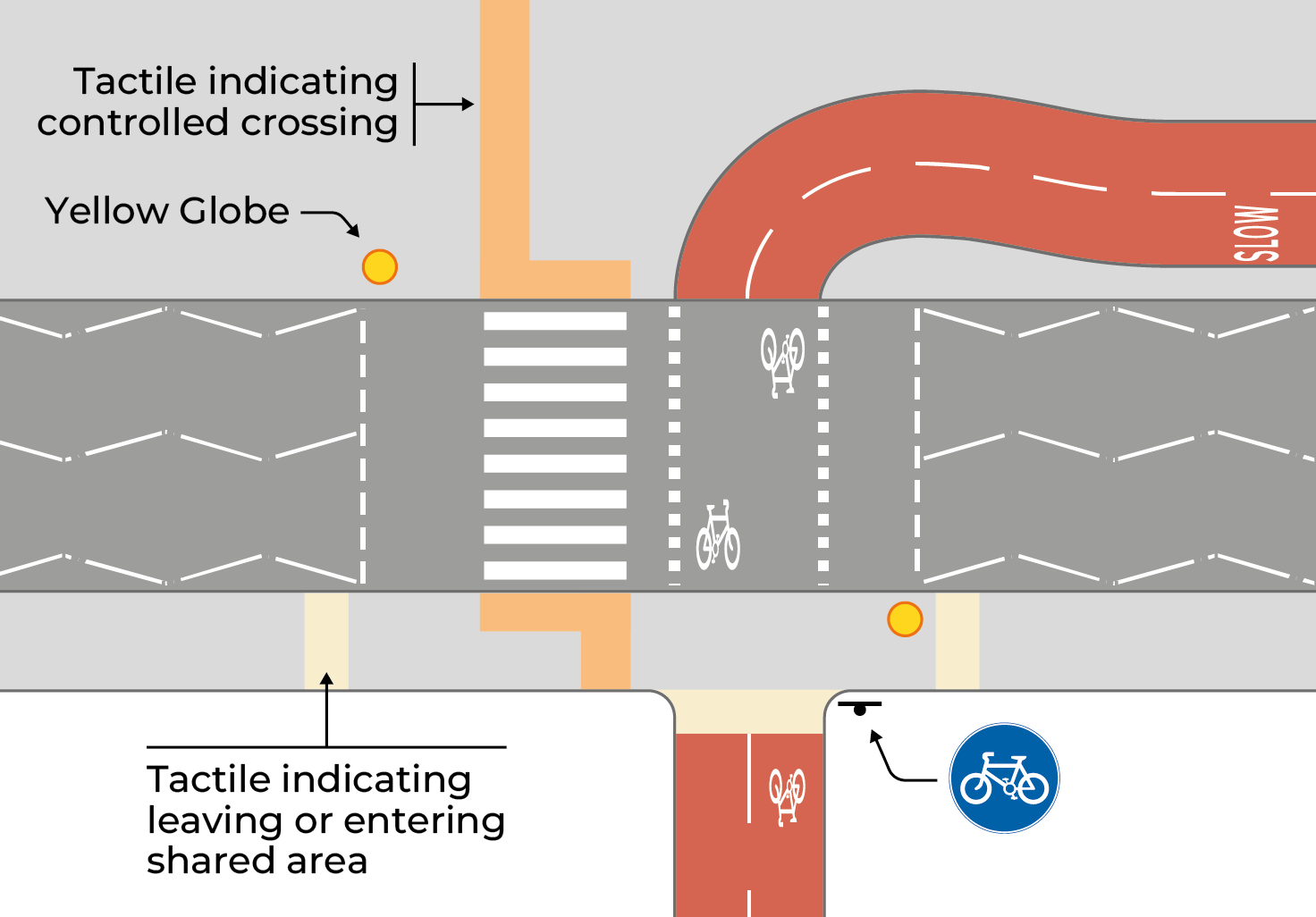
Figure 4.5 illustrates an example layout of a Parallel crossing for cycle users and pedestrians to cross a single carriageway road.
The example illustrates a protected parallel cycle track on the ‘north’ side of the road, and a remote cycle track meeting a footway on the ‘south’ side. Pedestrians and cycle users are provided with separate waiting areas on the ‘north’ side, with a shared waiting area shown on the ‘south’ side where space is more limited.
| Clause Number | Description |
|---|---|
| 4.4.5 | Parallel crossings should not be installed on roads with an 85th percentile speed of 35 mph (56 kph) or above without speed reducing measures to slow traffic, in accordance with Traffic Signs Manual Chapter 6. |
| 4.4.6 | A visibility envelope is required in accordance with Section 4.3. |
| 4.4.7 | Signs and markings should be in accordance with Traffic Signs Manual Chapter 6. |
| 4.4.8 | The facility should be designed for crossing the road in a single stage. |
| 4.4.9 | The route through the pedestrian element of the crossing should be a minimum of 2.4 m, and may be wider determined by the pedestrian crossing demand. |
| 4.4.10 | The route through the cycle users' element of the crossing should be at least the same width as the adjoining cycle route and a minimum of 3.0 m for two-way and 1.5 m for one-way operation. |
Uncontrolled crossings and interactions
Uncontrolled crossings provide users of one facility the opportunity to cross another facility with the lowest level of control of users. The Sustainable Travel Hierarchy requires pedestrians to be given precedence and places greater importance on cycle users than motor traffic. However, the speed, nature and volume of motor traffic can make it more naturally dominant at points of interaction, and uncontrolled crossings do little to redress this. These crossings will therefore provide a lower level of service for cycle users than alternative crossing types in most situations.
Uncontrolled solutions are relatively inexpensive to install and maintain, and likely to have relatively low visual and environmental impact on the surrounding area. They are most likely to be suitable in conditions of low use and low motor traffic speed. Where motor traffic speed or volume is high other options should be considered.
In many circumstances where roads and cycle routes interact at an uncontrolled crossing, the cycle user will be required to give way. Where this is not appropriate and a greater level of cycle user priority is desired, a greater level of control is necessary.
Features of an uncontrolled crossing may include:
- Traffic signs and road markings to advise and regulate the movement of users
- Physical infrastructure to accommodate users crossing, e.g. dropped kerbs and tactile paving.
Guidance on tactile paving and dropped kerbs is contained in Guidance on the use of Tactile Paving Surfaces and in Roads for All: Good Practice Guide for Roads respectively.
Due to the high degree of interaction and low level of control, appropriate visibility at such crossings is essential.
At most uncontrolled crossings and interaction points, priority will be assigned to one route over another. This is essential at roads where motor traffic is involved. It is also usually appropriate where cycle user and pedestrian facilities interact. Assigning priority is potentially less necessary where:
- The mode of user on both facilities is the same
- The mode of user is at low speed and volume is not excessive
- Any conflict between users results in minimum risk.
In such scenarios users may be able to moderate their behaviour without the use of signage, road markings or infrastructure. Such situations are most likely to occur in low flow areas and require good visibility between users to ensure they are aware of the situation and can identify and react to any potential conflict as they approach.
Cycle user and pedestrian interactions
Where cycle user routes and pedestrian routes meet, three potential situations may arise:
- Cycle users give way to pedestrians (e.g. entering a shared use waiting area)
- Pedestrians give way to cycle users
- No formal priority is assigned, and all users are required to interact.
Situations where pedestrians give way to cycle users are most likely to occur at crossings where cycle routes are continuous, and the pedestrian volume is low. They may occur where a cycle track passes kerbside activity areas such as on-street parking and loading bays. If the provision of such a facility does not offer an adequate and safe opportunity for pedestrians, then an alternative arrangement will be necessary.
Suitable crossing facilities, including dropped kerbs and tactile paving are required.
Adequate visibility along the cycle track (dependent on speed) is required from a position within the pedestrian facility where it meets the cycle track.
A typical uncontrolled crossing layout where pedestrians give way to cycle users is illustrated in Figure 4.6.

| Clause Number | Description |
|---|---|
| 4.5.1 | A visibility envelope should be provided in accordance with Section 4.3. |
| 4.5.2 |
The minimum width of dropped kerb at the crossing should be 1.2 m as advised in Roads for All: Good Practice Guide for Roads, and may be wider to accommodate the pedestrian crossing demand. Note: A 2.0 m width will allow two wheelchair users to pass on the crossing. |
| 4.5.3 | Dropped kerbs should be 'flush' with the cycle track, with the permissible tolerance being up to 6 mm. |
| 4.5.4 | SLOW markings on the cycle track may be used to warn cycle users of the interaction ahead. |
Cycle user and road interactions
Cycle user routes may meet roads at crossings or at junctions where cycle users are required to join the carriageway. Priority is always assigned at the interaction point between motor traffic and cycle users. The speeds and potential consequences of a collision where motor traffic is involved are greater than at other interaction points.
Where the road is assigned priority, cycle users are required to give way, and adequate visibility of the road is required from a position within the cycle route. Features will vary depending on the situation. In situations where a cycle-only route intersects directly with the road, markings are required, as illustrated in Figure 4.7.
However, in many cases the cycle user will have entered a shared use waiting area with pedestrians. In such cases tactile paving and dropped kerbs will define the interface with the road.

| Clause Number | Description |
|---|---|
| 4.5.5 | A visibility envelope is required in accordance with Section 4.3 at all uncontrolled interactions between a cycle route and a road. |
| 4.5.6 | Where an off-line cycle track interfaces directly with a road, a minimum corner radius of 4.0 m should be provided. |
| 4.5.7 | Signs and markings should be in accordance with Traffic Signs Manual. Where the cycle facility interacts directly with the road, road markings (including TSRGD Diagram 1003B) should be used on the cycle facility to define the need for users to give way. |
Uncontrolled single carriageway crossing – urban situation
Figure 4.8 illustrates an example of an uncontrolled crossing layout for a cycle user route and associated pedestrian route, crossing a single carriageway road in an urban setting. A shared use waiting area is illustrated.
Parking and street furniture can affect visibility at crossing locations and may have to be limited to meet visibility requirements. Where the road is subject to on-street parking, the provision of build-outs can reduce the crossing length, assist in achieving the required visibility envelope, and enable users to wait at the crossing without impeding pedestrians proceeding along the footway. The location of build-outs should not create pronounced ‘pinch-points’ on the road carriageway, as this can compromise the safety of road users.
In low speed environments it may also be desirable to provide a raised table at the crossing to control the speed of motor traffic and reduce the change in level for crossing users, though this is more commonly applied at controlled crossing facilities.

Uncontrolled single carriageway crossing – rural situation
Figure 4.9 illustrates an example of an uncontrolled layout for a cycle route crossing a single carriageway and interacting with a footway running parallel to one side of the road. A shared use waiting area is illustrated.
This scenario may be more typical of a rural situation with fewer roadside features but potentially higher motor traffic speed. Where uncontrolled crossings of the carriageway are provided, it is important that traffic speed is not excessive to enable safe crossing. Mitigating measures such as warning signage can be used to reduce motor traffic speed and reduce the risk associated with the crossing. The risk increases with traffic speed, and grade separation is preferable where motor traffic speeds are high.
Central refuges are not provided for crossings on single carriageways where the speed limit exceeds 40 mph, unless the refuge island is incorporated into a single lane dualling design.

Uncontrolled dual carriageway crossing
Another potential scenario is where cycle user facilities cross a dual carriageway. At-grade crossings will often be undesirable in this scenario if traffic speeds are high, and grade separation would potentially provide a more attractive option. Mitigating measures such as warning signage can be used to reduce motor traffic speed and reduce the risk associated with the crossing.
Figure 4.10 illustrates an uncontrolled crossing of a dual carriageway. Shared use waiting areas are illustrated. A shared use waiting area is provided on the central reserve at dual carriageway crossings so that the crossing can be carried out in two stages.
A straight across crossing is generally preferred as staggered crossings can be difficult to negotiate, particularly by those using larger cycles. They can also cause delay and give rise to potential conflict between cycle users and pedestrians within the central reserve.
If staggered crossings are provided it is essential that the central reserve can accommodate the design parameters for the design cycle and a two-way cycle track (including pedestrian facilities where appropriate). A short stagger offset between the two crossings will allow a smoother and more comfortable path through the central reserve for cycle users than the provision of tight, right-angled turns.

| Clause Number | Description |
|---|---|
| 4.5.8 |
The central reserve should be a minimum width of 3.0 m measured perpendicular to the road. This width is exclusive of hard strips. Note: Where this cannot be achieved, the Design Review process will be used to provide justification to allow acceptance or consideration of alternatives by the Overseeing Organisation (refer to Chapter 2). |
| 4.5.9 | Additional width may be necessary to provide clearance to any fixed objects (refer to Chapter 3). |
| 4.5.10 | The width of the crossing through the central reserve should not be less than that of the adjoining facility and should be a minimum width of 2.5 m. |
Cycle priority crossings
Cycle routes may be given priority over lightly-trafficked roads in situations where motor traffic speeds are low. This arrangement incorporates standard give-way markings on the road (to TSRGD Diagram 1003A), requiring motor traffic to give-way to cycle users. A layout is illustrated in Figure 4.11.
Opportunities to provide cycle user priority are most likely to arise in new developments and in situations where a cycle track has been taken off-line at a junction to cross a side road.
In situations where cycle users are assigned priority, it is vital that drivers are clearly aware of the facility, and that motor traffic speeds approaching the crossing are not excessive. The visibility of the cycle track from the road is defined by a conventional visibility splay using X and Y dimensions.
Where pedestrians are to be accommodated, the Sustainable Travel Hierarchy should be considered. Parallel crossings may provide a more suitable alternative where pedestrians and cycle users are required to cross together.

| Clause Number | Description |
|---|---|
| 4.6.1 | Cycle priority crossings should not be provided where the speed limit on the road is greater than 30 mph. |
| 4.6.2 | A visibility envelope is required in accordance with Section 4.3, with the cycle track defined as the through route, and therefore ensuring visibility of the cycle track from the road. |
| 4.6.3 | A speed table with ramps not exceeding 1:10 may be applied, to control the speed of motor traffic and reduce the change in level for cycle users as they cross the road. |
| 4.6.4 | The cycle track surface material and colour should continue across the crossing to visually emphasise priority. |
| 4.6.5 | SLOW markings on the cycle track may be used to warn cycle users of the interaction ahead. |
Signal-controlled crossings
Signal-controlled crossings are generally suitable in urban areas where user volume is relatively high.
Signal-controlled crossings are generally only used to address the crossing of a road. They have a relatively higher installation and maintenance cost than uncontrolled or other controlled crossings. Where interactions arise between cycle users and pedestrians without adjacent motor traffic, these can be adequately controlled without traffic signals.
Signal-controlled crossings incorporating cycle facilities may include:
- Where pedestrians cross a road and an adjacent cycle facility (Puffin crossing)
- Where cycle users (often with pedestrians) cross a road.
Several features of a signal-controlled crossing will apply regardless of the specific layout. Suitable crossing facilities, including dropped kerbs and tactile paving are required. Facilities to emphasise the crossing and to slow drivers, such as speed tables, may also be incorporated.
Guidance on tactile paving and dropped kerbs is contained in Guidance on the use of Tactile Paving Surfaces and in Roads for All: Good Practice Guide for Roads respectively.
Audible and/or tactile signals should be provided where crossings serve pedestrians, for the benefit of blind and partially sighted people.
Signal control means that visibility of the opposing route for those waiting to cross a facility is less important than at other crossing types. However, crossing locations should not be obscured, and visibility to the appropriate signal head on the approach (for motor traffic and cycle users) and from the kerb line (for pedestrians and cycle users) is essential.
Puffin crossing incorporating a cycle track
A signal-controlled pedestrian crossing can be used where a road has adjacent cycle routes.
Figure 4.12 illustrates an example layout of a signal-controlled crossing for pedestrians (Puffin) to cross a cycle track and road. The cycle user facility in the illustrated example is a protected two-way cycle track on one side of the road only.
Where signal-controlled pedestrian crossings cross a cycle track and road, the crossing should be continuous across both, i.e. the cycle route is included within the controlled area of the crossing. This applies whether the cycle route is protected or not.
Pedestrian crossing times are calculated based on the combined width of the road and the cycle route. The length of the cycle user phase will correspond to that of the road.
Kerbside detectors may be incorporated to enhance the crossing facility. These can sense when a pedestrian has crossed or moved away after pushing the demand button, in which case the demand is cancelled. Detectors can also sense pedestrians on the crossing and hold all vehicles at a red signal until they have crossed. Where appropriate, pedestrians can be given the default green signal, especially at times of the day when traffic flows are low.

| Clause Number | Description |
|---|---|
| 4.7.1 | Signal controlled crossings should not be provided where the 85th percentile speed of motor traffic is greater than 80 kph. |
| 4.7.2 | The minimum width (between the two rows of studs) for pedestrians should be 2.4 m, and may be wider determined by the pedestrian crossing demand. |
| 4.7.3 | Where a speed table is provided, the length (relative to the direction of motor traffic) should be defined by the width of the crossing. |
| 4.7.4 | Signal timings to allow pedestrians to cross should be in accordance with Traffic Signs Manual Chapter 6. |
Signal timings to accommodate cycle users
The regularity and time given to each user at a signal-controlled crossing is dependent on flow balances and demand, and the length of the crossing. Often, green time is allocated by default to one route (motor traffic) with time given to other routes (pedestrian and cycle) by request only. To better align with the Sustainable Travel Hierarchy, it may be desirable in some locations for a higher proportion of green time to be given to the pedestrian and cycle routes by default.
Signal timings are required to consider cycle movements in two aspects:
- The green time given to cycle users crossing
- The intergreen time given to cycle users to clear the crossing after the green time expires.
Guidance for calculating signal timings for cycle users is provided in Traffic Signs Manual Chapter 6. The minimum green time provided to cycle users is 7 seconds, but this may be increased to allow for higher proportions of cycle traffic. The use of on‑crossing detection can also help by automatically extending crossing times when needed.
The design parameters for cycle users at traffic signals are shown in Table 4.4. These have been used to calculate the intergreen times in Table 4.5. Where the crossing has an uphill gradient of greater than 3% the parameters are adjusted to reflect slower cycle acceleration and speed on the crossing. At a crossing, the path difference represents the length of the crossing.
| Parameter | Value | Notes |
|---|---|---|
| Acceleration | 0.5 m/s2 | Less than 3% uphill gradient |
| Acceleration | 0.4 m/s2 | Equal to or more than 3% uphill gradient |
| Design speed | 20 kph | Less than 3% uphill gradient |
| Design speed | 15 kph | Equal to or more than 3% uphill gradient |
| Path difference | Flat, downhill or uphill gradient of less than 3% | Uphill gradient of 3% or more |
|---|---|---|
| 1 to 3 metres | 5 seconds | 5 seconds |
| 4 metres | 5 seconds | 6 seconds |
| 5 to 9 metres | 6 seconds | 6 seconds |
| 10 to 14 metres | 7 seconds | 8 seconds |
| 15 metres | 8 seconds | 8 seconds |
| 16 to 18 metres | 8 seconds | 9 seconds |
| 19 to 21 metres | 9 seconds | 10 seconds |
| 22 to 23 metres | 9 seconds | 11 seconds |
| 24 to 27 metres | 10 seconds | 11 seconds |
| 28 to 33 metres | 11 seconds | 13 seconds |
| 34 to 36 metres | 12 seconds | 14 seconds |
Detectors on the approaches to signal-controlled crossings can enable the cycle green phase to be called in advance of a cycle user arriving at the shared use waiting area or stop line at junctions. Where a cycle track passes through a series of signal-controlled junctions, consideration can be given to coordinating the signals to provide a green wave for cycle users, based on the cycle user design speed.
| Clause Number | Description |
|---|---|
| 4.7.5 | The minimum green time for cycle users on a crossing should be 7 seconds, in accordance with Traffic Signs Manual Chapter 6. |
| 4.7.6 |
The intergreen time to allow cycle users to clear the crossing should be in accordance with the values provided in Table 4.5, where the path difference represents the length of the crossing. Note: The path differences identified can also be used in the design of signal-controlled junctions, see Traffic Signs Manual Chapter 6. |
| 4.7.7 |
Where a crossing is shared with pedestrians, the intergreen times may have to be extended to accommodate pedestrian crossing requirements. Note: A walking speed of 1.2 m/s is conventionally used to calculate timings for pedestrian crossings. Note: A lower walking speed of 1.0 m/s to suit slower moving pedestrians may be used, either on a site‑by‑site basis or as an area‑wide policy. |
Signal-controlled cycle crossings
Signal controlled crossings can be provided to enable cycle users to cross a road. In many cases pedestrian crossing facilities will also be incorporated.
Where cycle users and pedestrians both have to cross a road, the crossing may be arranged as follows:
- In a shared crossing, where the cycle users and pedestrians cross together (as in a Toucan arrangement)
- In separate facilities.
Separate facilities can provide a better level of service by reducing conflict between different users, but potentially require a larger area and greater crossing width.
Crossings are designed as a single stage without the need for users to wait on refuge islands. Push button or demand units have to be positioned where waiting pedestrians and cycle users can reach them easily, including by cycle users who are low to the ground (recumbent cycle users) or seated well back from the front wheel.
If a nearside signal aspect for pedestrians and cycle users is used, it should be positioned so that users look towards approaching traffic when looking at the signal. Nearside signal aspects at crossings can often be obscured by waiting pedestrians, and to address this (particularly at busy locations) a second, higher level signal on the near side may be provided.
Additional detectors may also be required on wider crossings to detect users on the crossing and hold road traffic at a red signal until they have crossed.
Figure 4.13 illustrates an example Toucan crossing layout where a shared cycle track crosses a road and its associated parallel footways. A shared use waiting area is illustrated to enable cycle users and pedestrians to interact safely before crossing.
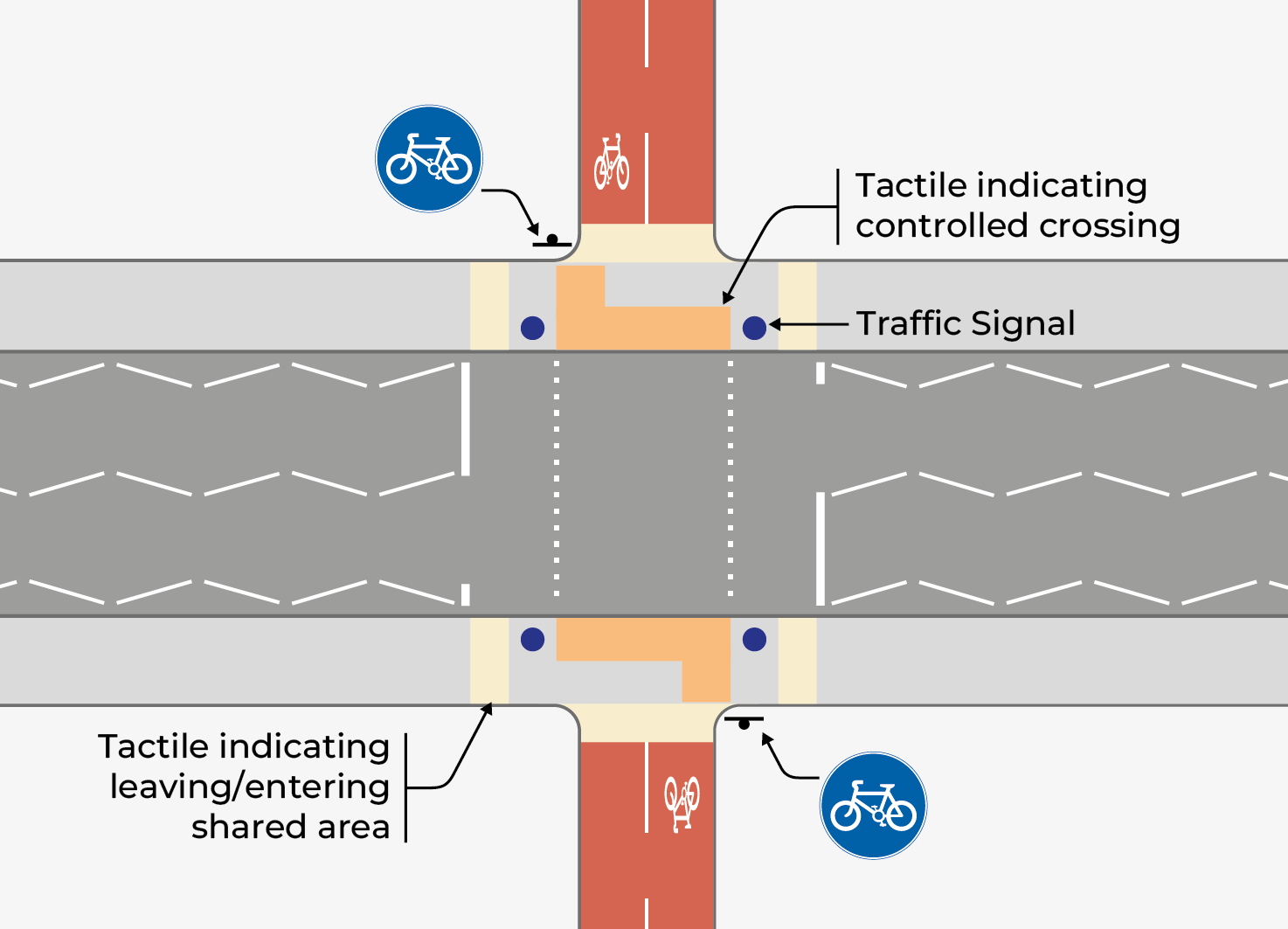
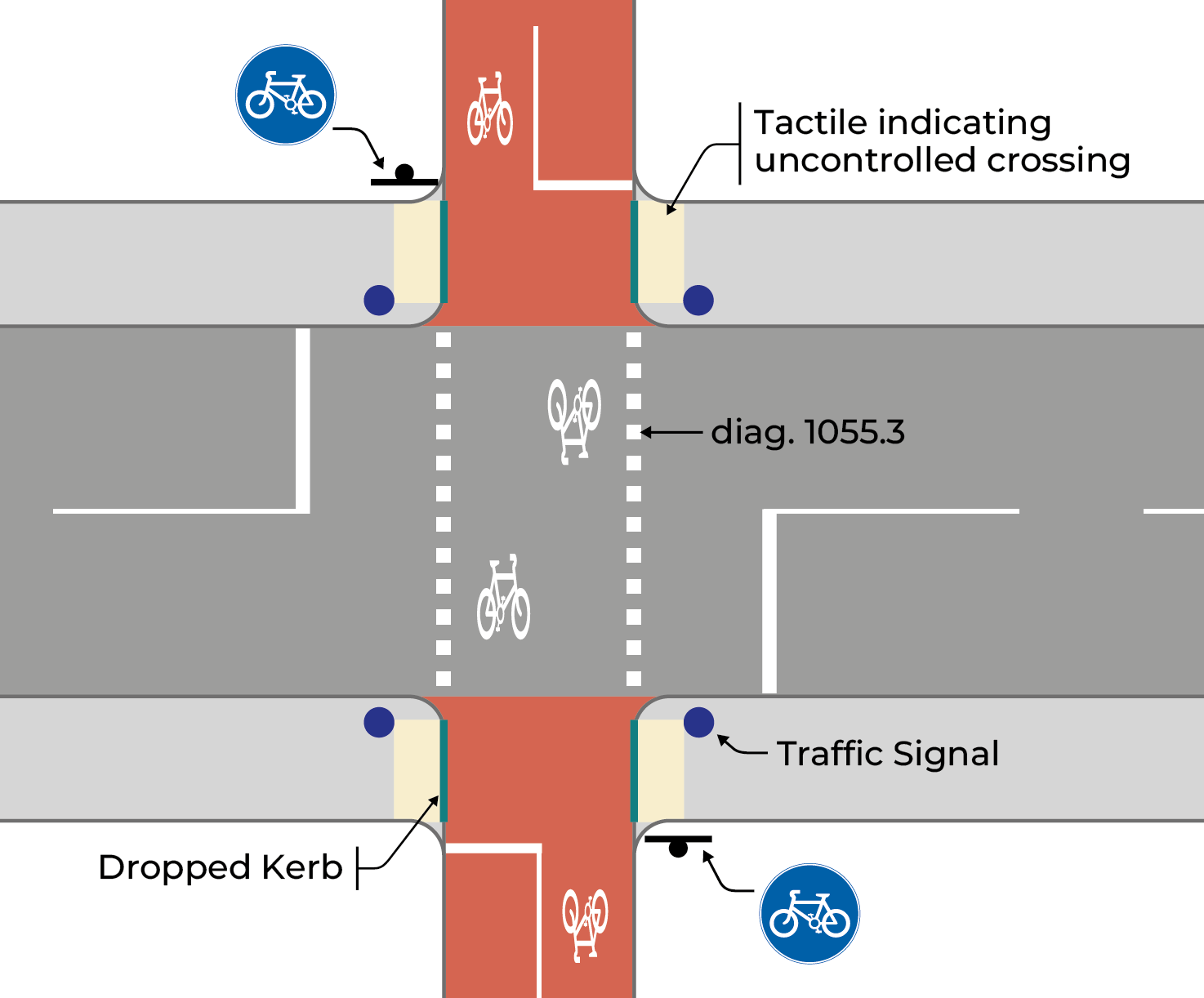
Figure 4.14 illustrates an example signal-controlled crossing where a cycle track crosses a road and its associated parallel footways, independent of a pedestrian crossing. The cycle track is extended through the footway to form a junction with the road. The cycle track stop line is located at the back of the footway to minimise conflict and enable pedestrians to cross the cycle track when the cycle signal is red.
| Clause Number | Description |
|---|---|
| 4.7.8 | Signal controlled crossings should not be provided where the 85th percentile speed of motor traffic is greater than 80 kph. |
| 4.7.9 | Where cycle users and pedestrians cross together at a Toucan crossing, the minimum width of the crossing should be 4.0 m. |
| 4.7.10 | Where the cycle crossing does not accommodate pedestrians, the crossing should be at least the same width as the adjoining cycle facility and a minimum of 3.0 m for two-way and 1.5 m for one-way operation. |
| 4.7.11 | Where a separate pedestrian crossing is provided near a signal-controlled cycle crossing this should be in accordance with Traffic Signs Manual Chapter 6. |
Grade separated crossings
Grade separation can overcome potential interaction by separating routes completely, either by overbridges or underbridges.
By separating cycle users and pedestrians from motor traffic the risk of collisions can be avoided. It is also possible to reduce delay by eliminating waiting times, though increased journey distance to access the overbridge or underbridge may add to journey time.
Grade separated crossings tend to be more expensive and have a higher visual and environmental impact on the surrounding area due to the additional infrastructure and space requirements. They may not always be affordable or desirable, and are unlikely to be an appropriate or desirable solution in low speed, low volume ‘street’ environments. Each individual case has to be assessed on its own merits.
Grade separation is likely to be considered as the most suitable solution where:
- Collision risk and/or severance is considered high
- Motor traffic speeds are high (typically 85th percentile speeds in excess of 85 kph)
- Peak period cycle flows are high
- A crossing site assessment identifies that traffic conditions are not suitable for an at-grade crossing
- Existing infrastructure can be adapted to accommodate users
- Cycle desire lines can be accommodated
- The topography is suitable.
The decision whether to provide an overbridge across the road or an underbridge crossing beneath the road will be influenced largely by the topography and layout of the surrounding area. A direct route through the crossing is preferred to routes that require substantial deviation from the desired line of travel.
The composition of users is also relevant in defining which grade separated facility is most suitable, due to the different needs of users. An underbridge can provide benefits to cycle users in terms of gaining and maintaining momentum through the structure, whereas this is not an advantage for pedestrians.
Other aspects which influence the choice of an overbridge or underbridge include:
- The height difference to be overcome for an underbridge is less than an overbridge because the clearance requirement for cycle users is less than for motor vehicles. This has the potential to result in lower and shorter approach gradients, subject to site topography and layout
- Cycle users and pedestrians are less open to the elements in an underbridge
- Underbridges tend to have a lesser visual impact, thereby preserving landscape, visual amenity and any architectural heritage benefits.
Underbridges can result in perceived (and potentially actual) personal security issues, due to the lack of visibility of the location and potential for anti-social behaviour. While this can be somewhat mitigated through appropriate design, this type of infrastructure can still deter a number of people from using the route, particularly at night. This will need to be considered at the options appraisal stage to support the Overseeing Organisation’s Public Sector Equality Duty.
Ramps to access grade separated facilities
Access ramps on approach to both overbridges and underbridges have to be designed with emphasis on accessibility. Roads for All: Good Practice Guide for Roads provides requirements relating to accessibility, including advice on ramps, landings, tactile paving and handrail requirements.
Access ramps and stairways should be at least the same width as the overbridge or underbridge, and ramp gradients should comply with the guidance provided in Chapter 3. An access ramp should incorporate appropriate horizontal landings. Guidance on the total rise between landings is provided in Roads for All: Good Practice Guide for Roads.
Wheeling ramps may be provided on stairways (on both sides), but cognisance must be taken of handrail requirements.
Straight ramps are generally preferable for cycle users. A helical ramp may be provided where suitable and should be of adequate width to allow two cycles to pass comfortably while turning.
Where steps are provided tactile paving should be included on the approach, to warn blind or partially sighted people. Guidance on tactile paving is contained in Guidance on the use of Tactile Paving Surfaces.
Underbridges
Cycle users can be accommodated in new-build underbridges or existing pedestrian underbridges converted to include cycle users.
A significant aspect in the success of an underbridge facility is ensuring that it is safe, secure and attractive to users. It is essential to mitigate any concerns over personal safety. This can be achieved through:
- Optimising through-visibility and natural light
- Maximising headroom within the facility
- Minimising the perception of enclosed space
- Minimising the length of the underbridge.
Through-visibility is a function of width, height and tapering, and good lighting (including natural light). Natural light can be increased by angling wing walls to maximise penetration of daylight. Headroom requirements should be maintained throughout the full length of the structure and should not be compromised by access ramps running into the covered area.
Where the underbridge incorporates a separated pedestrian facility, the pedestrian facility headroom can be 100 mm less than the adjacent cycle track headroom, to allow for the provision of a kerb.
Whilst a rectangular cross-section is illustrated in Figure 4.15, circular or other shaped sections may be used where they circumscribe a rectangular section with the required dimensions.

Underbridge facilities will typically accommodate both pedestrians and cycle users. It is preferable to separate these users within the space rather than providing a shared route. Kerb separation is preferred. For a shared route to be successful, the existing and predicted desire lines should be assessed for both pedestrians and cycle users.
Surface drainage needs to be appropriately considered, with adequate combinations of crossfall and longitudinal gradient provided to avoid ponding of surface water.
| Clause Number | Description |
|---|---|
| 4.8.1 | Stopping sight distance for the appropriate design speed should be provided through an underbridge (see Chapter 3). |
| 4.8.2 | The minimum cross sectional width and clearances for both shared use and separated cycle track facilities through a new underbridge should conform to the general width requirements for that type of cycle link, as outlined in Chapter 3. |
| 4.8.3 | Where an existing underbridge is converted to accommodate cycle users, the absolute minimum total width of the facility may be reduced to 3.0 m. This may be divided to provide absolute minimum cycle track and footway widths of 1.5 m each. |
| 4.8.4 | Headroom requirements for underbridges should be as defined in Table 4.6. Relaxations to absolute minimum values may only be applied where existing structures are converted for cycle facilities. |
| Facility | Underbridge length less than or equal to 23 m | Underbridge length more than 23 m |
|---|---|---|
| Cycle track or shared facility - desirable minimum headroom | 2.4 m | 2.7 m |
| Cycle track or shared facility - absolute minimum headroom | 2.2 m | 2.2 m |
| Separated pedestrian facility - desirable minimum headroom | 2.3 m | 2.6 m |
| Separated pedestrian facility - absolute minimum headroom | 2.2 m | 2.2 m |
Overbridges
Cycle users can be accommodated on new-build overbridges or existing overbridges converted for, or developed to include, cycle users.
An overbridge is often regarded as a less desirable option than an underbridge, but may be more appropriate in some situations, including:
- Where the local topography is not appropriate to accommodate an underbridge
- Where an underbridge would result in significant environmental impact including visual impact
- Where an underbridge would require long diversions via ramps
- Where an existing overbridge provides an opportunity to provide a suitable cycle facility.
Overbridge facilities will typically accommodate both pedestrians and cycle users. It is preferable to separate these users within the space rather than providing a shared route. Any separation has to be compatible with that provided on the overbridge approaches. For a shared route to be successful, the existing and predicted desire lines should be assessed for both pedestrians and cycle users.
A proposal to convert an existing footbridge or road overbridge should be assessed on its own merits in consultation with all parties potentially affected. The layout and details of the existing overbridge and its current usage should be reviewed alongside the quality of other possible routes.
Parapet heights should be considered, and specific risk assessment is required where an existing parapet height of less than 1.5 m is proposed for use.
Suitable mitigation measures where a parapet height of less than 1.5 m is proposed to be retained can include (but are not limited to):
- Separation of pedestrians and cycle users by means of a delineator strip
- Tonal contrast or surface texture with pedestrians placed next to the parapet
- An advisory line keeping cycle users away from the parapet
- Monitoring of use for a suitable period.
| Clause Number | Description |
|---|---|
| 4.8.5 | Stopping sight distance for the appropriate design speed should be provided across an overbridge (see Chapter 3). |
| 4.8.6 | The minimum cross sectional width and clearances for both shared use and separated cycle track facilities across an overbridge should conform to the general width requirements for that type of cycle link, as outlined in Chapter 3. |
| 4.8.7 | The minimum parapet height on new overbridges serving both cycle users and equestrians should be 1.8 m. |
| 4.8.8 | The minimum parapet height on new overbridges serving cycle users but not serving equestrians should be 1.5 m. |
| 4.8.9 |
On existing overbridges a reduction in the parapet height to an absolute minimum of 1.2 m may be considered, but will require an additional 0.5 m to the clearance distance defined in Chapter 3. Note: A risk assessment is required where an existing parapet height of less than 1.5 m is considered for use. |
Lighting at crossings
Crossings are often used during hours of darkness and it will be necessary to ensure that the crossing can be seen against the background of other lights and signs. Good road lighting will reduce most of the problems related to extraneous light sources, and an experienced lighting engineer should ensure that the level recommended in the appropriate guidance is used at all crossing sites.
If there is still doubt about the visibility of cycle users, then supplementary lighting can be provided to illuminate the crossing but should avoid glare to drivers which could hide or ‘veil’ cycle users, thus defeating the objective of its installation.
The cycle approach and waiting area (at least the area covered by the tactile paving surface) and the carriageway crossing area should be illuminated to a uniform level.
Guidance on the lighting of cycling infrastructure is provided in the Institution of Lighting Professionals, Professional Lighting Guide 23: Lighting for Cycling Infrastructure.