Junctions
Principles
Junctions on the road network are the locations where the greatest degree of interaction between cycle users, motor traffic and pedestrians is likely to occur. Therefore, determining the appropriate layout, and the correct method of managing the various interactions at a junction are fundamental to their success.
Junctions on the road network where cycle users and others are likely to meet include:
- Priority junctions
- Signal-controlled junctions
- Roundabouts (which can also incorporate signal-control).
The sections within this chapter are structured on this basis. The chapter provides guidance and defines requirements for full junction layouts, and measures which may be adopted within a junction layout to best facilitate cycle user and pedestrian movement.
Design of the most appropriate location, form of junction and crossing types requires a careful assessment. The design should aim for the highest level of service for the person cycling and it may be necessary to affect the wider traffic and network conditions to make the design suitable. Appropriate junction selection and design is based on a comprehensive understanding of the place and movement functions of the individual location, and considers the following:
- The relationship between the junction and the connecting cycle, pedestrian and public transport facilities, i.e. the surrounding network function
- Road users’ expectation of motor traffic speed and operation
- Traffic volume and turning movements (including cycle users and pedestrians)
- Desire lines, trip generators and attractors
- Injury accident record (at existing locations).
This information will allow the designer to fully consider the needs of all users. A full, on the ground, physical audit of the site is required to enable the designer to gain an appropriate understanding of the context and of existing facilities for cycle users and other users in the local area. Only then can the development of a final design be made using the appropriate design standards and guidance.
Additional guidance and standards relating to junction design can be found in relevant road authority guidance, including Designing Streets, The National Roads Development Guide, Roads for All: Good Practice Guide for Roads and the Design Manual for Roads and Bridges.
Interactions
Within a single junction there may be numerous individual interactions between intersecting routes and different users. An effective junction layout will successfully manage the various interactions which arise within it. These could include interactions between:
- Cycle users and pedestrians
- Cycle users and other cycle users
- Cycle users and motor traffic.
To improve the understanding of the management of interactions within the broader context of a junction, several scenarios have been considered. Example layouts are provided that apply the good practice from the preceding chapters of the guidance.
Limited guidance on the likely use of traffic signs and road markings is provided on the associated figures and in the supporting text. In practice, suitable junction arrangements will often require bespoke arrangements to resolve the various interactions arising in the most appropriate way. Designers should refer to Traffic Signs Manual and TSRGD for guidance on traffic signs and road markings.
At junctions where cycle users are required to join motor traffic routes, it is important that the layout enables them to adopt the primary riding position.
Priority junctions
Priority junctions occur where motor traffic is controlled by traffic signs and road markings only (without traffic signals). They operate on the simple basis of one route (the adjoining route) ceding priority to another (the through route). The adjoining route traffic only enters the through route where gaps in traffic allow this to happen. Priority junctions are typically arranged in a T-junction or crossroads layout and do not include roundabouts which represent a separate category of junction.
It is essential that the needs of pedestrians are fully considered in the selection and design of appropriate priority junction layouts. The Highway Code states that vehicles should give way to pedestrians crossing or waiting to cross a road into which or from which they are turning. Effective design of priority junctions can support this message.
Principles for effective priority junction design where pedestrians and cycle users are accommodated, consistent for all junction layouts, include:
- Sensitivity to the context of the location and the surrounding road network, i.e. ensuring that the junction form is appropriate for the conditions at the location
- Clear indication to all users of the junction form and priority, and of the expectations on users
- Low radius (or no radius) kerbs which allow direct routes across the junction for active travel users
- Discouragement of high vehicle turning speeds at the junction
- Adequate inter-visibility of users
Wherever pedestrians are required to cross a side road at a junction, the inter-visibility of users can be enhanced by extending the width between the side road edge and the barrier to visibility (such as a building line or parked cars), thus increasing the opportunity for a driver to see a pedestrian or cycle user crossing their route. This is illustrated in Figure 5.1. Features such as footway build-outs can provide this opportunity, while also discouraging high turning speeds.

The specific visibility requirements for each of the various junction layouts are presented in this section. The appropriate form of cycle facility at the junction will be influenced by the form of junction. Layouts presented in this section include:
- Junction between cycle tracks
- Continuous cycle track at a continuous footway
- Transition to cycle lane across a priority junction
- Cycle track at side road incorporating bend-out layouts
Hybrid layouts should be avoided, as these compromise coherence and can make the junction operation confusing for users. Uncertainty at priority junctions has been shown to lead to potentially hazardous situations.
Standalone signal-controlled cycle user and pedestrian crossing facilities should not be incorporated within road junctions which otherwise operate on a priority basis, unless located sufficiently far from the through route to avoid queuing back.
Level of Service Indicators – Priority Junctions
In relation to Design Principle – Directness
- High Level of Service: Motor traffic will need to give way to cycle users more often than cycle users will need to give way to motor traffic along a route
- Medium Level of Service: Cycle users will need to give way to motor traffic on a similar number of occasions as motor traffic will need to give way to cycle users along a route
- Low Level of Service: Cycle users will need to give way to motor traffic more often than motor traffic will need to give way to cycle users along a route
Junction between cycle tracks
Where two cycle tracks meet at an uncontrolled junction, two potential layouts may be provided:
- One route is assigned priority over the other
- No formal priority is assigned.
Priority may be determined by factors such as cycle flow, layout, coherence and consistency, i.e. priority would favour the straighter route, and any interactions with pedestrians and other vehicles at the location.
Assigned priority is most likely to be required where:
- Cycle volumes are high and there is greatest potential for interaction
- Intervisibility between cycle links is limited
- There is a clear case for providing priority to one route over the other.
An example layout where cycle users give way to other cycle users is illustrated in Figure 5.2.

| Clause Number | Description |
|---|---|
| 5.2.1 | Where priority is assigned, a visibility envelope should be provided in accordance with Chapter 4. |
| 5.2.2 | A minimum corner radius of 4.0 m should be provided. |
| 5.2.3 | Signs and markings to denote the need for users to give way should be in accordance with Traffic Signs Manual Chapter 3. |
Alternatively, the scenario being considered may lend itself to users being able to moderate their behaviour without the use of priority signage, road markings or infrastructure. Such situations are most likely to occur in low flow, often rural areas. This will require good intervisibility between facilities in advance of the junction, to ensure that users are aware of the situation and can identify and react to any potential conflicts as they approach.
Continuous cycle track at a continuous footway
Continuous footways provide a facility where the footway adjacent to the through route is extended across the side road. They provide a strong visual indication of pedestrian priority over turning motor traffic. They should only be used in situations where conditions are appropriate, driver expectations have been managed through network measures, and absolute priority for pedestrians can be clearly established. They are unsuitable and should not be used where mainline or side road speeds or turning volumes are excessive.
Continuous footways create potential for a high level of service for cycle users at the junction, as they enable the provision of a continuous cycle track on the through route, adjacent to the footway.
Continuous footway layouts incorporating adjacent cycle tracks are commonly and successfully used in several countries, but are a relatively new concept in Scotland. Their provision has potential to improve the continuity of cycling infrastructure and enable best practice examples to be developed and monitored, ensuring the needs of all users are correctly supported. Designers are encouraged to use the Design Review process outlined in Chapter 2 and seek approval from the relevant Overseeing Organisation when developing continuous footway layouts incorporating cycle tracks. Early engagement with relevant interested parties is an important step towards meeting the Overseeing Organisation’s Public Sector Equality Duty.
The example layout presented in both Figures 5.3 and 5.4 incorporates:
- A main road with a parallel cycle track and adjacent footway
- A side road with adjacent footways.


Junction operation
Continuous footways introduce a “drivable space”, across which vehicles entering and exiting the junction are required to travel, but which should clearly indicate through a series of physical measures that pedestrians are prioritised and footway conditions prevail. For continuous footways to operate effectively it is essential that motor vehicles speeds across the driveable space are significantly constrained, approximately to walking pace, to ensure safe and comfortable interactions.
The side road should be constrained on approach to the continuous footway, to ensure that only one vehicle can be crossing the footway at a time, and any vehicle wishing to enter in the opposite direction is required to wait. The principle of ensuring one-way operation of side road traffic at any one time can be favourable to ensuring the coherence of the facility.
The protected cycle track adjacent to the through route is at footway level through the junction area, and should therefore be raised in advance of the junction where necessary.
The application of this junction treatment can form part of wider network measures that will reduce the prevalence of through-traffic, meaning that it can be considered where a reduction in side road traffic to appropriate levels can be established.
Design features
Design features are required to ensure that drivers are aware they are entering a space where they give way to pedestrians and cycle users. It is essential that drivers turning into the side road have sufficient clear visibility of the cycle track and footway to allow enough time to react and wait before commencing their turn. Roadside parking and loading can restrict this inter-visibility and should be carefully considered.
One-way side roads reduce complexity and can present more suitable conditions for continuous footways. Where the side road is two-way it should be narrowed on approach to the junction, in advance of the continuous footway, to ensure that vehicles are unable to enter and exit at the same time.
Visibility of the main road from behind the give-way line may be inadequate to allow a driver to exit the side road in a single manoeuvre, with drivers required to check each individual facility as they approach. This encourages slow speeds as vehicles cross the footway and the cycle track. It may necessitate vehicles giving way to road traffic from the road edge and temporarily obstructing the cycle track and footway.
| Clause Number | Description |
|---|---|
| 5.2.4 | Continuous footways incorporating cycle tracks should only be used in locations where the main road and side road have a speed limit of 30 mph or less. |
| 5.2.5 |
Continuous footways incorporating cycle tracks should only be used in locations where side road traffic is low, and at least suitable for mixed traffic streets cycling (see Table 3.2 in Chapter 3). Note: Based on research of cycle track crossings at minor roads and of driver behaviour at continuous footways, these layouts have been observed to operate well at up to 100 vehicles per peak hour on the side road. |
| 5.2.6 | The footway material and colour on approach to the junction should be maintained across the side road and should visually contrast with the nearby carriageway. |
| 5.2.7 |
The cycle track colour at the junction should be distinct from the footway and from the adjacent roads, and the colour contrast should be maintained for a minimum of 10 metres on each approach to the side road (see Chapter 3 for recommended surface colouring). Note: The continuous appearance helps convey to drivers that they are crossing an area of driveable space, where they do not have priority. |
| 5.2.8 |
Prominent vertical features such as "Dutch entrance" style kerbs should be provided on entry to and exit from the driveable space, to significantly reduce traffic speed, emphasise priority, and enable continuous levels across the footway. Note: A Dutch entrance kerb features a steeper gradient to facilitate the transition from road level to footway level over a short distance, which slows drivers and allows the footway and the cycle track to remain flat and at the same raised level. It presents a continuation of the main road edge as it passes the side road, emphasising the continuous message. |
| 5.2.9 |
No kerbed radius should be provided on entry to or exit from the side road. Note: A kerbed radius facilitates higher turning speeds and increases the distance of the pedestrian and cycle route crossing the junction. |
| 5.2.10 |
The maximum width of the side road at the junction should be 4.5 m, maintained for a minimum length of 5.0 m beyond the back of the footway. Note: Where the side road is two-way, the side road should accommodate waiting vehicles in advance of the narrowed section. |
| 5.2.11 |
Adequate visibility of the cycle track and footway from the side road should be provided, and items such as street furniture which obstructs visibility should be avoided. Note: Visibility between side road traffic, the continuous footway and the cycle track are not subject to X and Y-distances detailed in Chapter 4. Safe operation is ensured by slowing exiting vehicles approximately to walking pace as they cross the drivable space. Note: By narrowing the width of the drivable space, the intervisibility between side road drivers approaching the junction, pedestrians using the footway and cycle users on the cycle track can be improved, as the clearance between the side road edge and any adjacent building lines is increased. |
| 5.2.12 | Visibility of the main road from the drivable space should be provided relative to the edge of the main road using the appropriate set-back (X-distance - see Chapter 4). |
| 5.2.13 | Give way road markings should not be provided at the continuous footway as these can compromise the continuous footway message. |
| 5.2.14 | Where the approaching cycle track is not at the same level as the footway, it should be raised to footway level at least 3.0 metres in advance of the drivable space, with a maximum longitudinal gradient of 1:20 relative to the footway. |
| 5.2.15 | No kerbing should be provided across (perpendicular to) the continuous cycle track or footway. |
Coherence is essential to providing a successful continuous footway. The treatment may be particularly suitable in situations where drivers are familiar with the layout (such as a residential court development).
The provision of a continuous footway incorporating a cycle track at several side roads will improve coherence for cycle users, set expectation for suitable driver behaviour, and therefore improve the level of service offered to users, but at each individual location the conditions have to be appropriate.
Construction considerations for continuous cycle tracks and footways
Block paving can offer a reasonable surface for cycle users, although it will require greater effort to cycle on than an asphalt surface. However, the availability of different coloured blocks can help delineate the cycle track from the carriageway and footway. Cobbles and setts are uncomfortable for cycle users and pedestrians and are generally a road surface material, although in heritage areas these could be sliced or planed to create a smoother surface for pedestrians.
Paving flags for cycle users are less suitable due to lower skid resistance and the potential for rocking and cracking, although they are likely to form the surface of many adjacent footways. Therefore, paving flags can offer a useful solution to provide the visual contrast between a footway and the carriageway and cycle track. This provides a continuous surface for pedestrians through the junction, and visual continuity of the footway should also be maintained through the junction.
In all circumstances, the base of the continuous cycle track and footway should be designed to reflect anticipated loadings, traffic volumes and ground conditions. Smaller paving units, potentially reinforced, with a rigid sub-base are recommended for the footway.
Cycle lane over side road layout
Where conditions are not suitable for a continuous footway which is obvious to all users, it is preferable to provide a more conventional priority junction which clearly indicates that pedestrians are required to cross the side road. Hybrid designs which incorporate aspects of continuous footways without providing absolutely clear indications of priority are not recommended.
Good practice principles relating to the Highway Code and the sustainable travel hierarchy remain relevant, such as discouraging high turning speeds and minimising crossing distances through low radius kerbs and good intervisibility. Parking in the vicinity of the junction can compromise this intervisibility. Additionally, speed control measures such as speed tables can be used at the crossing point, but these should not compromise the message to the pedestrian that a road is being crossed.
Level access to the road crossing is essential, through dropped kerbs or speed table provision. In all cases suitable tactile paving should be provided to indicate the crossing point at the edge of the footway.
Where an approaching cycle facility is a protected cycle track, it will be necessary to transition to a cycle lane as the route passes through the junction. This will enable main road vehicles to turn. The removal of the physical protection of cycle users through the junction means that this layout provides a lower level of service than the cycle track incorporated within a continuous footway.
The example layout presented in Figure 5.5 illustrates:
- A main road with a parallel cycle track and adjacent footway
- A side road with adjacent footways.
In terms of cycle user interaction, the cycle lane across the junction and the adjacent road represent the through route (with priority) and the side road represents the adjoining route.
Interaction between the cycle lane and traffic turning across it from the main road is controlled by drivers’ awareness of the rules of the Highway Code and the road markings of the cycle lane. As such, there is potential for cycle user priority to be undermined if the cycle lane and its users are not fully visible to turning vehicles.
Where this layout is provided it is important that the vehicle emerging from the adjoining route has adequate visibility of the through route (both the cycle track and the road) from behind the give way marking. This ensures that the emerging vehicle is not required to stop again within the cycle lane. It is also essential that motor traffic turning into the side road has clear visibility of the cycle lane and the approaching cycle track.
For the layout to operate safely and effectively for cycle users it requires low vehicle turning speeds. This can be achieved by minimising corner radii, which will also maintain pedestrian desire lines, minimise pedestrian crossing distances, and minimise the length of unprotected cycle lane. Entry and exit tapers for turning vehicles should not be used as these can encourage higher speeds.

| Clause Number | Description |
|---|---|
| 5.2.16 | This layout should only be used in locations where the main road speed limits do not exceed 30 mph. |
| 5.2.17 | Adequate visibility of both the cycle facility and the main road from the side road should be provided relative to the give-way line, using the appropriate set-back (X-distance - see Chapter 4). The vehicle emerging from the side road should not be required to stop within the cycle lane. |
| 5.2.18 |
Junction corner radii should be limited as far as is feasible and to an absolute maximum radius of 6.0 m to limit vehicle turning speeds. As advised in Designing Streets, large vehicles may need to use the full carriageway width to turn. Note: Radii of less than 6.0 m provide better conditions for cycle users and pedestrians. |
| 5.2.19 |
Physical protection of the cycle track on the approach to the priority junction should extended as far as is feasible, and terminated a maximum of 5.0 m from the commencement of the side road corner radius. Note: Extending the cycle track protection provides a higher level of service to cycle users and help to discourage high vehicle speeds into and out of the junction. Vehicle swept paths should be considered. |
| 5.2.20 | Where the approaching cycle track is not at the same level as the road carriageway, it should be transitioned to road level at least 3.0 metres in advance of the end of the physical protection, with a maximum longitudinal gradient of 1:20 relative to the road. |
| 5.2.21 | Give way markings should be provided, positioned on the junction side of the cycle lane. |
| 5.2.22 | Cycle lane provision should be continued through the junction using a longitudinal road marking to TSRGD Diagram 1004 (for the continuation of an advisory cycle lane) or TSRGD Diagram 1010 (for a cycle lane through a junction, which is more prominent where a cycle track transitions to a cycle lane through the junction). |
| 5.2.23 | The cycle lane should be coloured across the junction to ensure prominence. |
| 5.2.24 | The cycle route width should be maintained as it transitions from a cycle track to a cycle lane and continues across the junction. |
| 5.2.25 | Where a speed table entry treatment is provided, the speed table and associated ramps should not extend into or across the cycle lane. |
Cycle crossing at side road layouts
This scenario, sometimes referred to as a ‘bend-out’ crossing, is also used at priority road junctions to maintain a reasonably direct route for cycle users, but where a continuous footway is not suitable due to traffic volumes and/or speeds.
The layout requires the cycle facility, and any associated pedestrian facility, to be diverted further from the road junction and is therefore less direct and potentially less desirable than other layouts. This allows the pedestrian and cycle crossing of the side road to be offset from the road junction enabling a vehicle to stop if users are crossing. It also means that any vehicles waiting to enter the main road will not obstruct the cycle user and pedestrian route.
An important consideration is the separation between the road junction and the crossing location. A greater distance provides more storage space and may be necessary where large vehicles or greater traffic volumes are expected. However, this diverts cycle users and pedestrians further and requires more space, which is often not available in urban environments.
The example layout presented in Figure 5.6 incorporates:
- A main road with a parallel cycle track and adjacent footway
- A side road with adjacent footways.
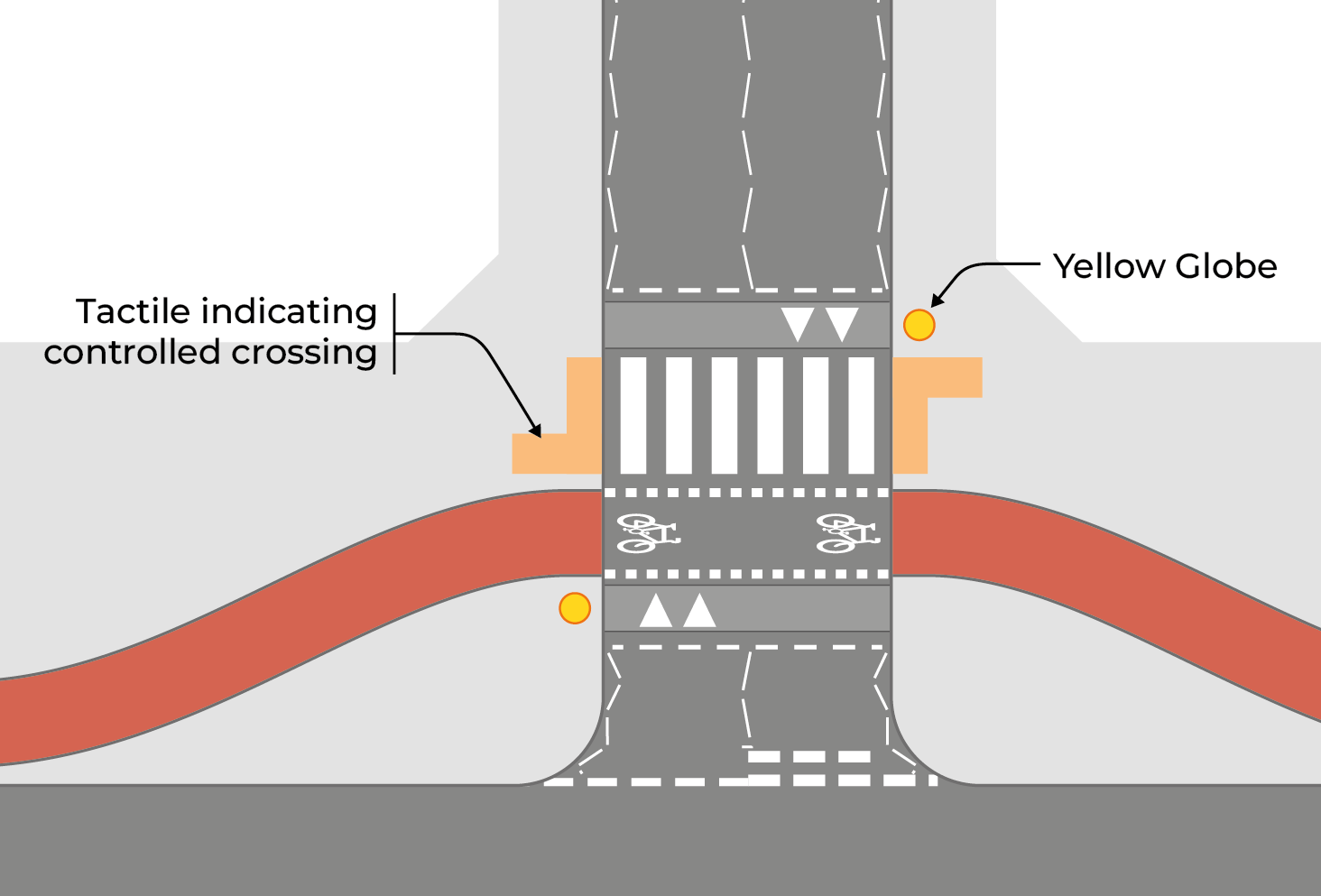
As the crossing point is offset from the junction, a range of options, including a controlled Parallel crossing and a signal-controlled crossing, can be considered. Where a standalone Parallel crossing is used, there must be enough space to accommodate the minimum requirements for zig-zag markings, as outlined in Traffic Signs Manual Chapter 6. Where a standalone signal-controlled crossing is used, the crossing should either be located sufficiently far from the through route that vehicles do not queue back into the main carriageway, or the whole junction should be signal-controlled, as also defined in as Traffic Signs Manual Chapter 6.
Figure 5.6 illustrates a controlled Parallel crossing of the side road that would benefit both pedestrians and cycle users.
| Clause Number | Description |
|---|---|
| 5.2.26 | Priority cycle track at side road layouts should only be considered where main road and side road traffic speeds are 40 mph or less, and should not incorporate a Parallel crossing at locations where the 85th percentile speed of motor traffic is greater than 35 mph (56 kph), in accordance with Traffic Signs Manual. |
| 5.2.27 | The minimum length between the road junction and the crossing location should be 5.0 m but should avoid excessive detours for cycle users and pedestrians. |
| 5.2.28 | The horizontal alignment of the cycle track should meet the requirements of Chapter 3. |
| 5.2.29 | The horizontal radius of the cycle track may be reduced to a minimum of 4.0 m on the immediate approach to the crossing (measured on the inside edge of the curve), which may discourage high cycle user speeds. |
| 5.2.30 | The cycle track through the crossing may be highlighted by providing a contrasting colour treatment. |
Cycle track and footway give way at side road layout
This scenario is also used at priority road junctions to maintain a reasonably direct route for cycle users, but where a continuous footway or controlled cycle crossing at side road layouts are not feasible due to traffic speeds exceeding 40 mph.
This layout is less direct for cycle users and pedestrians who will have to give way and will therefore be less desirable. However, it offers a degree of protection from turning traffic.
As with cycle crossings at side road layouts, an important consideration is the offset between the road junction and the crossing location. Where cycle users and pedestrians need to give way, the offset should be far enough to allow users to determine when motor traffic is about to turn into the junction.
The example layout presented in Figure 5.7 incorporates:
- A main road with a parallel cycle track and adjacent footway
- A side road with adjacent footways.
In terms of cycle user interaction, the side road represents the through route (with priority) and the cycle track (and the adjacent footway) represents the adjoining route. The main road does not interact with the cycle route.
Figure 5.7 illustrates an uncontrolled cycle/pedestrian crossing of the side road. Further advice on details at crossings, including visibility and infrastructure requirements, is included in Chapter 4.
| Clause Number | Description |
|---|---|
| 5.2.31 | The desirable minimum length between the road junction and the crossing location should be 10.0 m. Excessive detours for cycle users and pedestrians should be avoided. |
| 5.2.32 | The desirable minimum length between the road junction and the crossing location at minor private accesses should be 5.0 m. |
| 5.2.33 | The horizontal alignment of the cycle track should meet the requirements of Chapter 3. |
| 5.2.34 | The horizontal radius of the cycle track may be reduced to a minimum of 4.0 m on the immediate approach to the crossing (measured on the inside edge of the curve), and may discourage high cycle user speeds. |

Signal-controlled junctions
Traffic signals can be used at junctions to control the flow of traffic between interacting routes and provide safe crossing locations for pedestrians and cycle users. They operate by separating movements in time, so that each movement can make safe and efficient use of the space available.
The aim is to reduce the risk of collision between different movements, whilst maximising capacity and reducing delay for all users. Several factors can influence how this is achieved, including the available space, the different movements and traffic volumes to be accommodated, and the control strategy for the sequencing of traffic signal phases.
This section presents examples of full junction layouts incorporating cycle facilities. It also identifies treatments which can be incorporated within junctions to enable safe cycle movement. Guidance is provided on the allocation of space and management of signal timings to support cycle user movements. Layouts presented comprise:
- Protected signal-controlled junction layouts
- Two-stage right-turn layout
- Hold the left turn layout
- Cycle bypass layout
- Cycle gate layout
- Advanced stop lines (ASL) layout.
While the layouts provided apply the good practice presented in earlier chapters, suitable junction arrangements will often require more bespoke arrangements to resolve the various interactions in the most appropriate way, and to consider the competing demands.
The guidance provided for these example layouts is based on improving the attractiveness of cycle facilities at junctions for all users, particularly less experienced users. Where guidance is likely to provide benefit to experienced cycle users only, this is highlighted.
Additional facilities for cycle users at signal-controlled junctions can be particularly valuable to less experienced users. An example is a balancing aid at traffic signals, to be used by cycle users who require a physical prompt/assistance when pushing off from a stationary position at a red light.
Refer to the Traffic Signs Manual Chapter 6 for the calculation of traffic signal timings for cycle users.
Level of Service Indicators – Signal-controlled Junctions
In relation to Design Principle – Directness
- High Level of Service: The overall delay for cycle users at the junction is less than the overall delay for motor traffic
- Medium Level of Service: The overall delay for cycle users at the junction is equal to the overall delay for motor traffic
- Low Level of Service: The overall delay for cycle users at the junction is greater than the overall delay for motor traffic
In relation to Design Principle – Safety
- High Level of Service: Cycle users are separated from conflicting motor traffic in both time and space when moving through the junction
- Medium Level of Service: Cycle users are provided with separate time to move through junction from conflicting motor traffic, but may share the same space
- Low Level of Service: Cycle users share the same space as motor traffic and move through the junction at the same time
Protected signal-controlled junction layouts
Protected signal-controlled junction layouts provide separate space, in an orbital cycle track, and time for cycle users, allowing them to proceed safely at a separate time to motor traffic and to maintain a reasonably direct route.
These layouts offer the best combination of safety and directness for inexperienced cycle users to negotiate a signal-controlled junction and should be considered as the preferred signal-controlled layouts where the space is available to accommodate them.
Protected signal-controlled junctions are a relatively new concept for road and street networks in Scotland. Where they are proposed, designers are encouraged to use the Design Review process outlined in Chapter 2 and seek approval from the relevant Overseeing Organisation when developing protected signal-controlled layouts.
A protected signal-controlled junction layout enables cycle track users to make all desired movements around the junction separate to motor traffic. Also, subject to signal staging and timing, right turns may be achievable in a single movement and with little delay. To encourage use by cycle users, it is beneficial to minimise the additional distance required to negotiate the junction and timings can be managed to ensure predominant cycle movements are not disadvantaged relative to general traffic, especially during peak periods. Any significant delay or detour could encourage cycle users to use the road to travel through the junction, thus diminishing the value of the protected facilities.
The layouts provided illustrate two variations on the protected signal-controlled junction:
- Full signal control – Figures 5.8 to 5.10
- Zebra crossings of the cycle track – Figures 5.11 to 5.14.
These example layouts provide guidance for 4-arm junctions with cycle tracks on all arms. The principles of the guidance can equally be applied to 3-arm junctions or to situations where cycle tracks are only present on some of the approach arms.
In all scenarios presented, the cycle track crossing of the road is separated from the pedestrian crossing the road, and all cycle and motor traffic movements are signal- controlled. It is important that a consistent approach is applied across all arms of the junction to ensure familiarity and understanding by all users.
The key design principles are:
- Pedestrian crossings of the cycle track and road carriageway should be on clear desire lines and should be as consistent as possible to ensure familiarity by all users
- The layout should avoid cycle track users stopping any more than is necessary to manage the interaction with motor traffic
- Visibility at interaction points should meet the necessary requirements
- Space should be taken from the road carriageway rather than from the pedestrian footway.
| Clause Number | Description |
|---|---|
| 5.3.1 | Dimension R(a) (Figure 5.8, Figure 5.10 and Figure 5.11) should be designed to facilitate all expected left-turning vehicle movements, but should be a maximum of 6.0 m to limit vehicle turning speeds. |
| 5.3.2 | Dimension R(b) and R(c) (Figure 5.8, Figure 5.10 and Figure 5.11) should be a minimum of 4.0 m. |
| 5.3.3 | Cycle crossings of the road carriageway and pedestrian crossings of the cycle track/road carriageway should occur at the same level. |
| 5.3.4 | If the approaching cycle track is not at the same level as the carriageway, it should be lowered to carriageway level in advance of the stop line with a maximum longitudinal gradient of 1:20. |
| 5.3.5 | The cycle track through the junction may be highlighted by providing a contrasting colour treatment. |
| 5.3.6 | SLOW markings on the cycle track to TSRGD Diagram 1058.1 may be used to warn cycle users they are approaching the junction. |
Protected junctions – full signal-controlled layouts
Full signal-controlled layouts require pedestrians to cross the road and the associated cycle track in a single movement. Therefore, crossing timings are to be set to enable crossing of the full width of both facilities.
The advantages of full signal-controlled layouts include:
- Less space is required than for layouts with a zebra crossing of the cycle track
- Pedestrians have more controlled priority (and potentially greater perception of safety) over the cycle track than for layouts with a zebra crossing of the cycle track. This may be desirable where cycle volumes are high and pedestrian crossing opportunities would otherwise be limited.
The disadvantages of full signal-controlled layouts include:
- A longer signal-controlled pedestrian crossing is required, therefore increasing the time required for the pedestrian crossing phase and contributing to overall delay at the junction.
Figures 5.8 and 5.9 illustrate an example layout of a protected signal-controlled junction with full signal control. This layout has no internal cycle stop lines, requiring separate cycle user and pedestrian stages in the signal cycle.

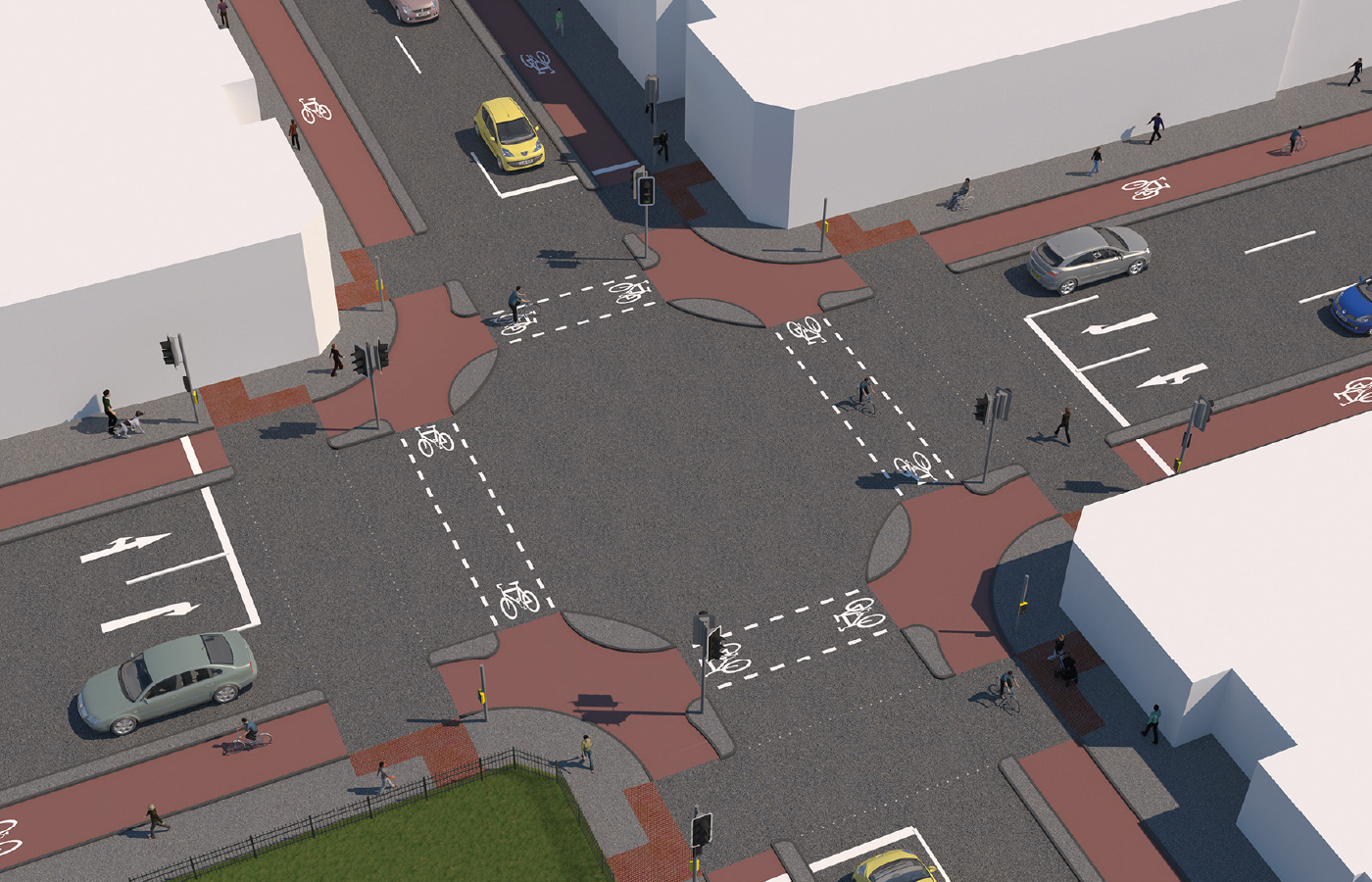
Where more space is available, internal stop lines can be incorporated which potentially offer cycle users more green time within the signal cycle by allowing left-turning cycle users to proceed when pedestrians are held.
This is particularly beneficial for left-turning cycle users who will be able to proceed without any delay during most stages of the signal cycle. However, to ensure that cycle users recognise the additional stop lines and traffic signals that are introduced within the junction, additional space is required to provide a greater distance and deflection between the cycle stop lines. More delay may be introduced for some cycle users, who may have to stop and regain momentum at more than one signal stop line. Careful consideration is needed on the level of delay this introduces and the possibility of non-compliance by cycle users, especially those who are only intending to turn left across the pedestrian crossing. This is illustrated in Figure 5.10. Changes in surface material to emphasise this change can be considered.
It is important for designers to consider the space available for cycle users to wait in this arrangement. If insufficient space is made available for the expected number of cycle users, they will potentially block back across the pedestrian crossing area.
Care is also needed to ensure that the additional infrastructure can be designed to be sympathetic to the overall place context of the area.

Protected junctions with Zebra crossings of the cycle track
As an alternative layout, protected junctions with a Zebra crossing of the cycle track offer less delay and more convenience to cycle users but require more space to accommodate the layout. The pedestrian crossing of the cycle track is not signal-controlled and is enabled by a Zebra crossing. The pedestrian crossing of the road is signal-controlled.
Therefore, the pedestrian crosses the cycle track and the road in separate stages and requires a landing area between the cycle track and the road. This maintains the concept of providing safer junction layouts for cycle users while also allowing signal-controlled pedestrian and cycle user phases to run simultaneously across the road in a single signal- controlled stage.
It is important that pedestrian crossings of the cycle track are located on the pedestrian desire line. In most cases the crossing of the cycle track should be in line with the pedestrian crossing of the road carriageway, though it may be offset if there is a need for pedestrians to access other facilities on the separation island, such as a bus stop.
The advantages of layouts with Zebra crossings of the cycle track include:
- Cycle users can filter left onto and off the orbital route without signal control
- Cycle users can proceed without stopping where there are no pedestrians waiting to cross
- Signal-controlled pedestrian crossings of the road will be shorter than a full signal-controlled layout, introducing less overall delay to the junction.
The disadvantages of layouts with Zebra crossings of the cycle track include:
- More space is required than for fully signal-controlled layouts, to accommodate the pedestrian landing area. Build-outs can provide an opportunity to create the required separation
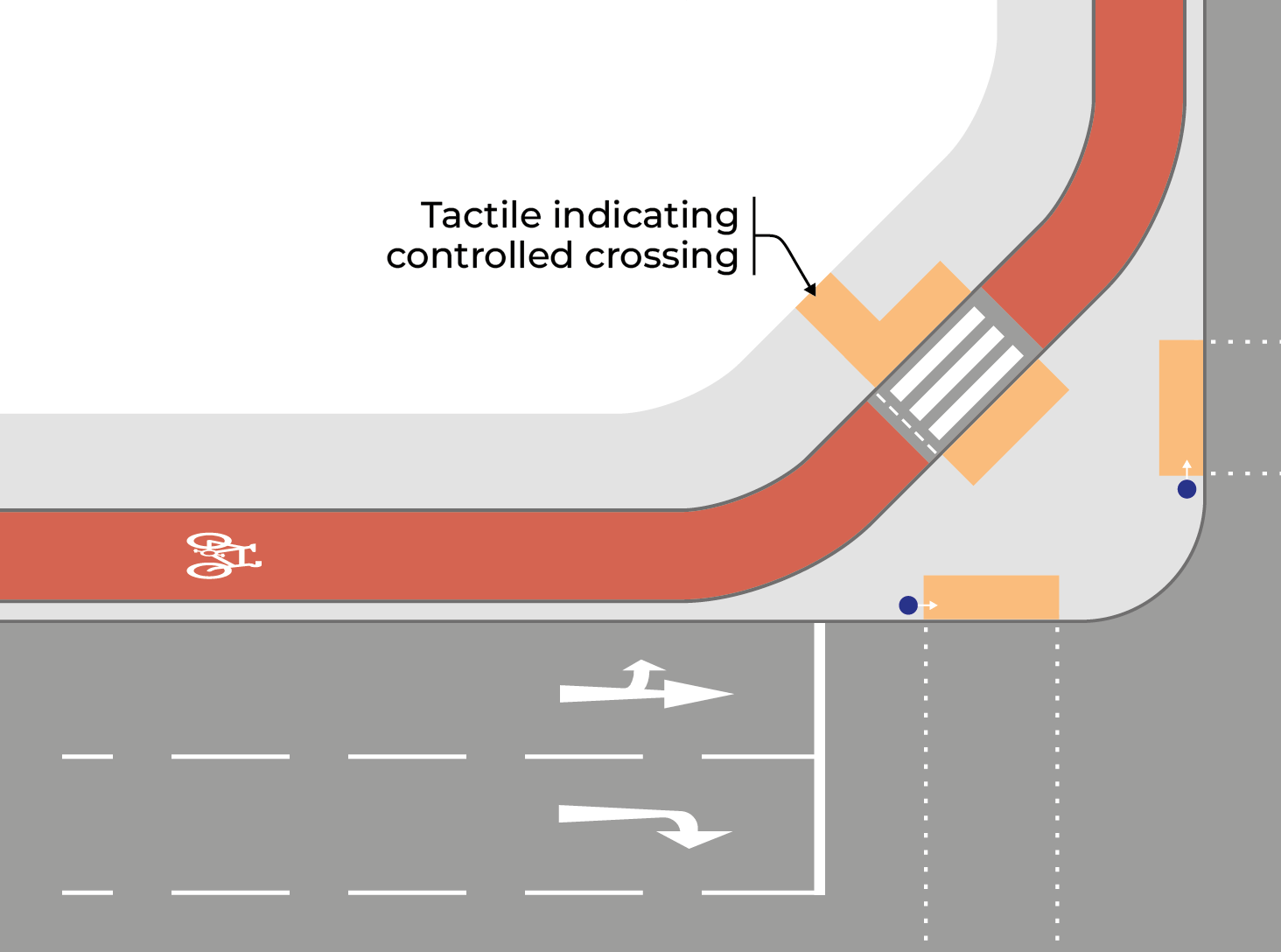
- Blind and partially sighted users may be less comfortable with this layout and feel more isolated on the pedestrian landing area. It is therefore critical to provide clear information (through road markings, correctly positioned poles and tactile paving) and enough space for all users to make the layouts comfortable. It is also vital to provide consistency in how these crossings are applied within each junction and on closely spaced junctions on a route to ensure familiarity by all users
- Visibility requirements of the cycle track at crossing points is greater than for signal-controlled crossings (refer to Chapter 4).
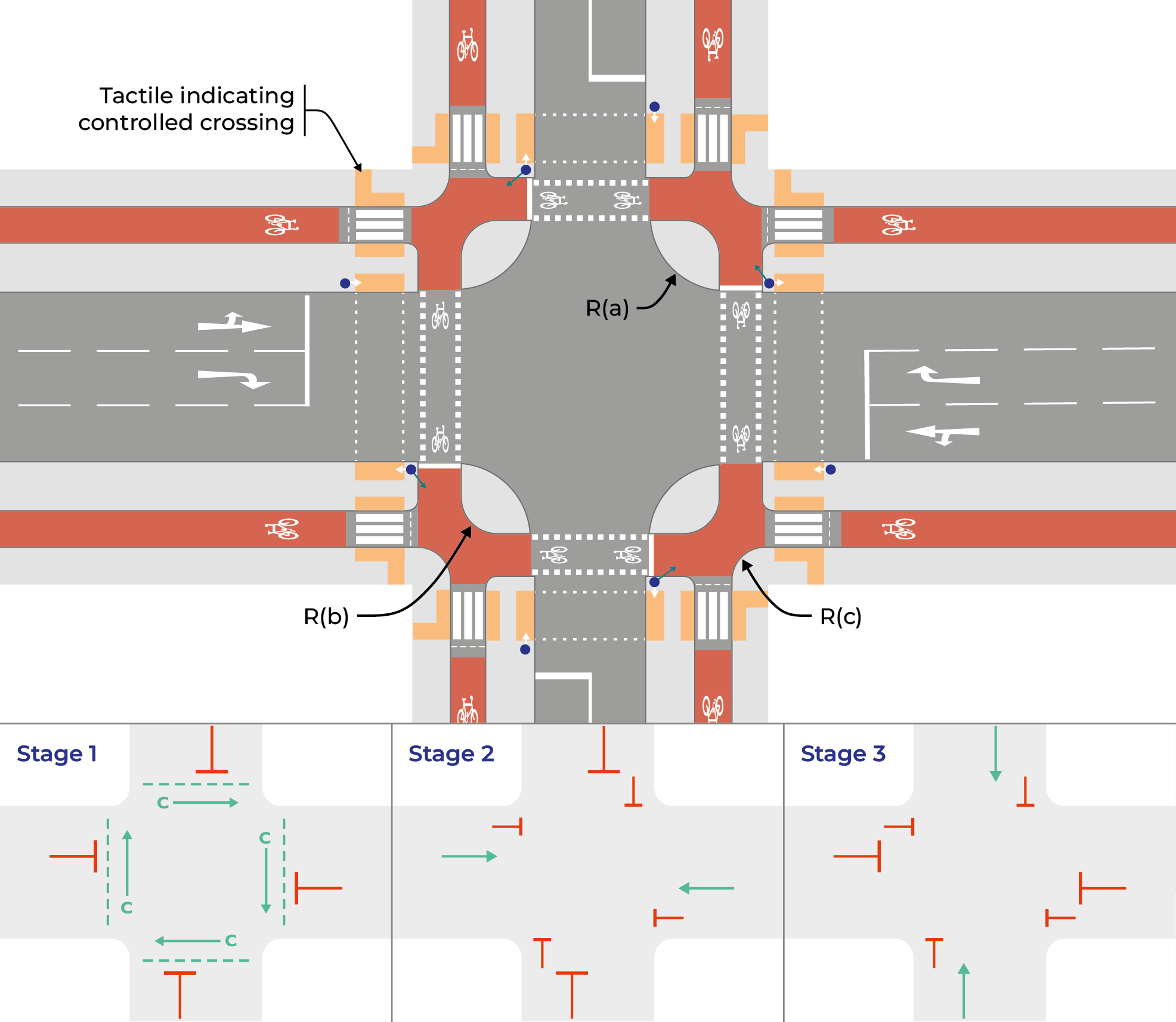
Figures 5.11 and 5.12 illustrate an example layout of this type of protected junction with Zebra crossings of the cycle track.
| Clause Number | Description |
|---|---|
| 5.3.7 | The width of the pedestrian landing area, between the crossing of the cycle track and the signal-controlled crossing of the road, should be a minimum of 2.7 m between kerbs to allow for tactile paving at each crossing point and a space between these. |

Protected junctions with Zebra crossings of the cycle track – CYCLOPS layout
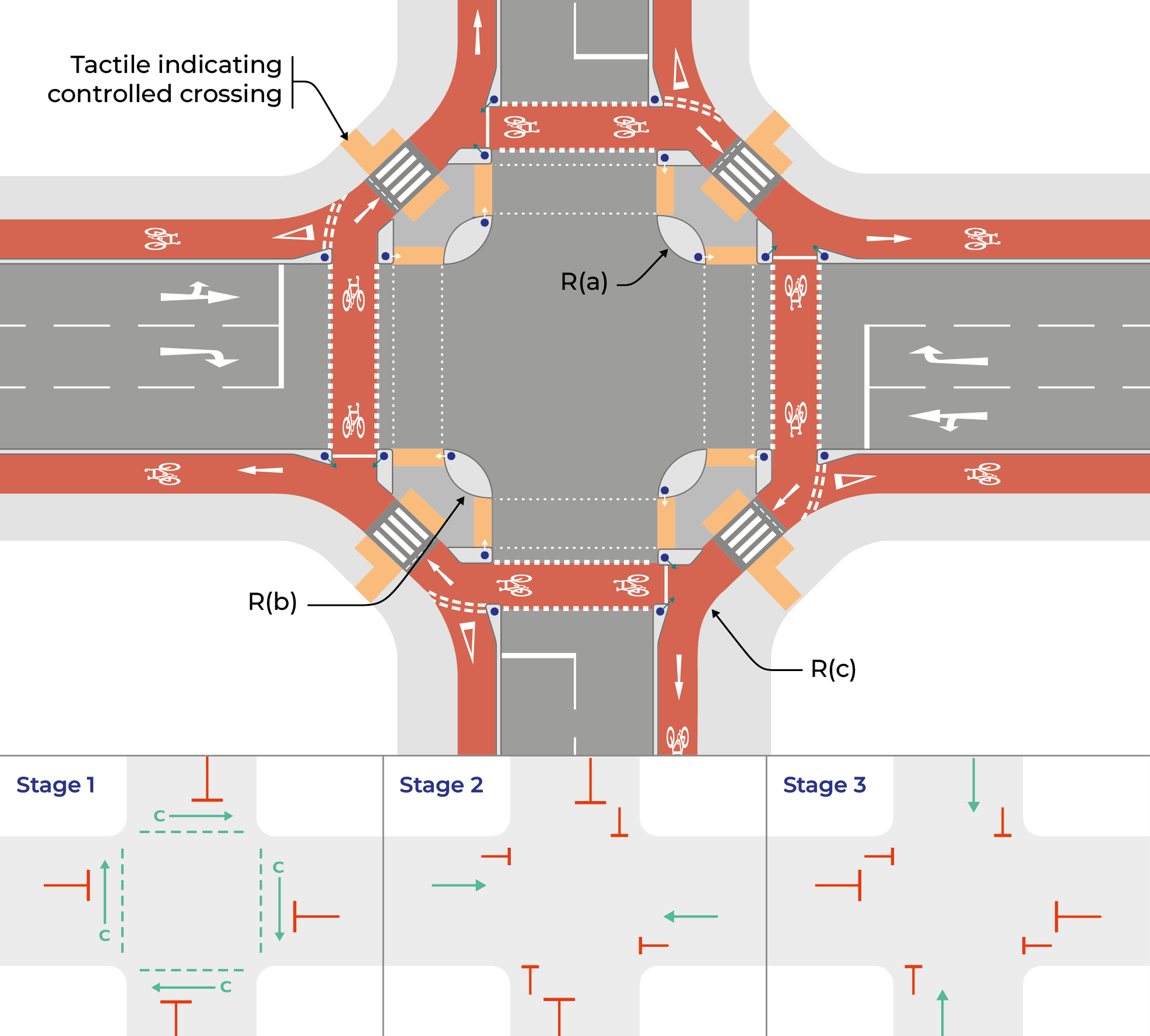
Another alternative incorporating Zebra crossings of the cycle track is the CYCLOPS (cycle optimised protected signal) layout. This is a variation of the layout illustrated in Figure 5.13 with the principle feature of an external orbital cycle track rather than the internal orbital cycle track provided in the examples above. This maintains the concept of providing safer junction layouts for cycle users while also allowing signal-controlled pedestrian and cycle user phases to run simultaneously in a single signal-controlled stage.
The pedestrian crossing of the cycle track is not signal-controlled and is enabled by a Zebra crossing. The pedestrian crossing of the road is signal-controlled. Therefore, pedestrians require a landing area between the cycle track and the road. Pedestrian crossings of the cycle track should be on the pedestrian desire line.
The layout reduces the number of pedestrian crossings on the cycle track network by consolidating all pedestrian movements into a single crossing point on each corner, with fewer Zebra crossings of the cycle track required when crossing more than one arm of the junction, compared with the example illustrated in Figure 5.11.
Figure 5.13 illustrates an example layout of a CYCLOPS protected junction.
The CYCLOPS layout shares similar advantages and disadvantages with other layouts incorporating Zebra crossings, when compared to fully signal-controlled junctions.
Further advantages of the CYCLOPS layout compared to other signal-controlled layouts include:
- The external orbital cycle track potentially provides an improved angle of approach for cycle users and additional space for queuing at cycle user stop lines
- Potentially more direct routes for pedestrians on desire lines, including an opportunity to incorporate diagonal pedestrian crossings of the junction (not illustrated).
The disadvantages of the CYCLOPS layout include:
- Potentially increases the route length for cycle users
- Pedestrians may feel less comfortable with this layout compared to other protected signal-controlled layouts, and potentially more isolated on landing areas
- Blind and partially sighted users may find landing areas more difficult to negotiate than the landing areas illustrated in Figure 5.11
More space may be required for large enough landing areas to accommodate the appropriate tactile paving and a space between these, as well as providing enough space to accommodate the competing pedestrian movements between two signal-controlled crossings of the road and the Zebra crossing of the cycle track.

Two-stage right-turn layout
A two-stage right-turn layout allows cycle users to turn right without having to move to the centre of the carriageway and can be beneficial on multi-lane approaches where motor traffic speed and volume make right turning from the road carriageway unattractive for cycle users. Signs located on the junction approaches and based on the map-type sign to TSRGD Diagram 2601.2 should be considered. As noted in Traffic Signs Manual Chapter 6, two traffic signs to support a two‑stage turn layout have been designed, although these will require authorisation.
The layout incorporates a waiting area for cycle users that is offset from vehicle movements on the main road arm and ahead of any stop lines or crossings on the side road arm. This is illustrated in Figure 5.15.
The right-turning arrangement for a cycle user is as follows:
- Cycle user enters the junction when their approach arm is given a green signal
- Cycle user pulls into the nearside waiting area, located within the side road arm, and waits
- When the side road arm is given a green signal, the cycle user is permitted to complete their turn across the junction
- Where “early release” phasing is incorporated, the cycle user can complete the right turn before motor traffic from the side road arm receives its green signal.
The right-turning cycle user in the waiting area is reliant on a secondary signal, located across the junction at the arm into which they are turning. It is essential that this signal is at a high level and clearly visible to the cycle user.
An early release signal can be beneficial in ensuring that the right-turning cycle user can complete their turn before motor traffic enters the junction. An “early release” is a green signal for cycle users that allows them to move off before other road users on the same arm of the junction.
This gives cycle users an advantage over other traffic to negotiate the junction and to make their intentions clear to drivers and other road users behind. An early release can be incorporated by providing the green cycle aspect prescribed in TSRGD diagram 3001.4, by low level cycle signals in TSRGD diagram 3000.2A, or both.
Two-stage right turns are often provided in conjunction with ‘hold the left turn’ layouts.
This layout involves a greater degree of cycle user and motor traffic interaction than protected signal-controlled junctions. It is therefore less preferable and may not be attractive to less-experienced cycle users. It may be considered where constraints mean that the higher provision of a protected junction cannot be reasonably accommodated.
| Clause Number | Description |
|---|---|
| 5.3.8 | The layout should provide sufficient space to allow cycle users to enter the waiting area and then position themselves correctly for their second stage. |
| 5.3.9 | The cycle waiting area should be completely offset from the traffic and cycle lane running parallel to it. |
| 5.3.10 | The cycle waiting area should be capable of accommodating a design vehicle 2.8 m long by 1.2 m wide and the total number of cycle users that are expected to make the turn within each signal cycle at peak times. |
| 5.3.11 | The waiting area should be highlighted by providing a contrasting colour treatment. |
| 5.3.12 | Where early release is incorporated, the far-sided secondary signal should turn to green at the same time as the low-level cycle signal for users waiting behind the stop line within the same arm. |

Hold the left turn layout
A ‘hold the left turn’ is a junction treatment used at signal-controlled junctions to enable cycle track users to gain the right of way before the associated motor traffic signal.
A nearside cycle track is given a dedicated green signal while motor traffic turning across the cycle track (typically the left turn but also any opposing right turn) is held on red. The turning motor traffic only receives a green signal when cycle users are held on red.
A hold the left turn facility is most appropriate where there is a moderate volume of left- turning traffic and a large cycle flow proceeding ahead and/or left. By allowing cycle track users to proceed at the same time as motor traffic proceeding straight ahead on the main road, it can often have the benefit of providing cycle users with a large proportion of the junction green time, thereby reducing delay.
It may also incorporate provision for right-turning cycle users. Where this is the case an associated two-stage right-turn facility should normally be provided.
An example layout is illustrated in Figure 5.16.
| Clause Number | Description |
|---|---|
| 5.3.13 | The cycle track should be physically protected from the left turn lane. |
| 5.3.14 | The left turn lane may be physically protected from the remaining traffic lanes. |

Cycle gate layout
A cycle gate facility is a treatment which can be applied at signal-controlled junctions that provides a reservoir area with separately controlled entry points for cycle track users and motor traffic.
It will have the greatest benefit where there is a high volume of cycle users proceeding straight ahead or turning right at signal-controlled junctions, or where there are many left-turning vehicles or ‘scissor movements’. This is most likely to be the case on key commuting routes with a high volume of peak period cycle track users and motor traffic.
A cycle gate relies on there being two sets of signals and two stop lines for cycle users on the entry arm. The first stop line acts as a ‘gate’ to allow cycle users to enter a ‘cycle reservoir’ ahead of motor traffic to await a green signal at the second stop line. This allows cycle users time and space to move away from a junction ahead of motor traffic.
The cycle gate operates on a sequence such that:
- The reservoir is clear when the cycle user signals turn green, so that cycle users can move to the front of the area
- The signals controlling the exit from the reservoir turn green in advance of those on the road traffic entry, to give cycle users in the reservoir the desired advantage.
The layout has some similarities to an advanced stop line (ASL) layout but provides a higher level of provision for cycle users. The layout removes the interaction that can occur when cycle users reach an ASL as the signals turn to green. It enables the provision of low-level cycle signals at the second stop line, to give an additional release to cycle users.
It is important that the cycle gate reservoir is not marked in such a way as to make it appear like an ASL. For example, it should not have coloured surfacing or be marked with cycle symbols. The cycle track on the approach may have coloured surfacing but this should terminate at the first cycle stop line.
A typical layout is illustrated in Figure 5.17.
| Clause Number | Description |
|---|---|
| 5.3.15 | The first motor traffic stop line should be positioned behind the first cycle user stop line. |
| 5.3.16 | The distance from the first motor traffic stop line to the second stop line, and therefore the reservoir length, should be a minimum of 18.0 m. |
| 5.3.17 |
The distance from the first cycle user stop line to the second stop line should be a minimum of 7.0 m. Note: Adequate distance between the stop lines will disassociate them from each other and reduce the see-through issue between the two sets of traffic signals. |
| 5.3.18 | The signal operation should give cycle users enough time to enter the junction before motor traffic enters the reservoir. Refer to Traffic Signs Manual Chapter 6 for guidance on signal timings. |

Advanced stop lines layout
Advanced stop lines (ASLs) provide a reservoir area at a signal-controlled stop line for cycle users to position themselves ahead of other traffic, as illustrated in Figure 5.18, but only when motor traffic is held at a red light. They are a low-cost intervention that have little impact on junction capacity if road traffic lanes are unaltered. In most cases, their installation at existing junctions will not require signal timing changes, with the potential exception of intergreen timings.
They give less protection than other examples presented in this guidance and are not suitable for all cycle users. Where space allows, the alternative layouts provided in previous pages should be considered first and may be more effective and offer a higher level of service.
ASLs can be effective for experienced cycle users on approaches where traffic flows do not exceed 5,000 vehicles per day, the road has a maximum of two traffic approach lanes, and where the approach receives no more than 30% of the cycle green time.
ASLs are intended to allow cycle users to adopt the appropriate position at the junction for their intended manoeuvre. The layout places cycle users in a more visible location ahead of traffic, rather than at a potential blind spot to the left of traffic, which is a hazard in the presence of HGVs. An ASL also allows cycle users to wait in an area relatively free from exhaust fumes and can make it easier for right-turning cycle users to position themselves in the best location.
For users who find it difficult to accelerate quickly, the ASL can be an uncomfortable position, located in front of traffic which has been given a green signal to proceed. This may particularly affect recumbent cycle users and inexperienced users.
Approach lanes feeding cycle users into ASLs are prescribed in TSRGD Diagram 1001.2. However these can place cycle users in a vulnerable position, particularly where the traffic signal changes to green before the ASL is reached by the cycle user. They are therefore not generally recommended and alternative layouts, described previously, are likely to offer a much better solution.
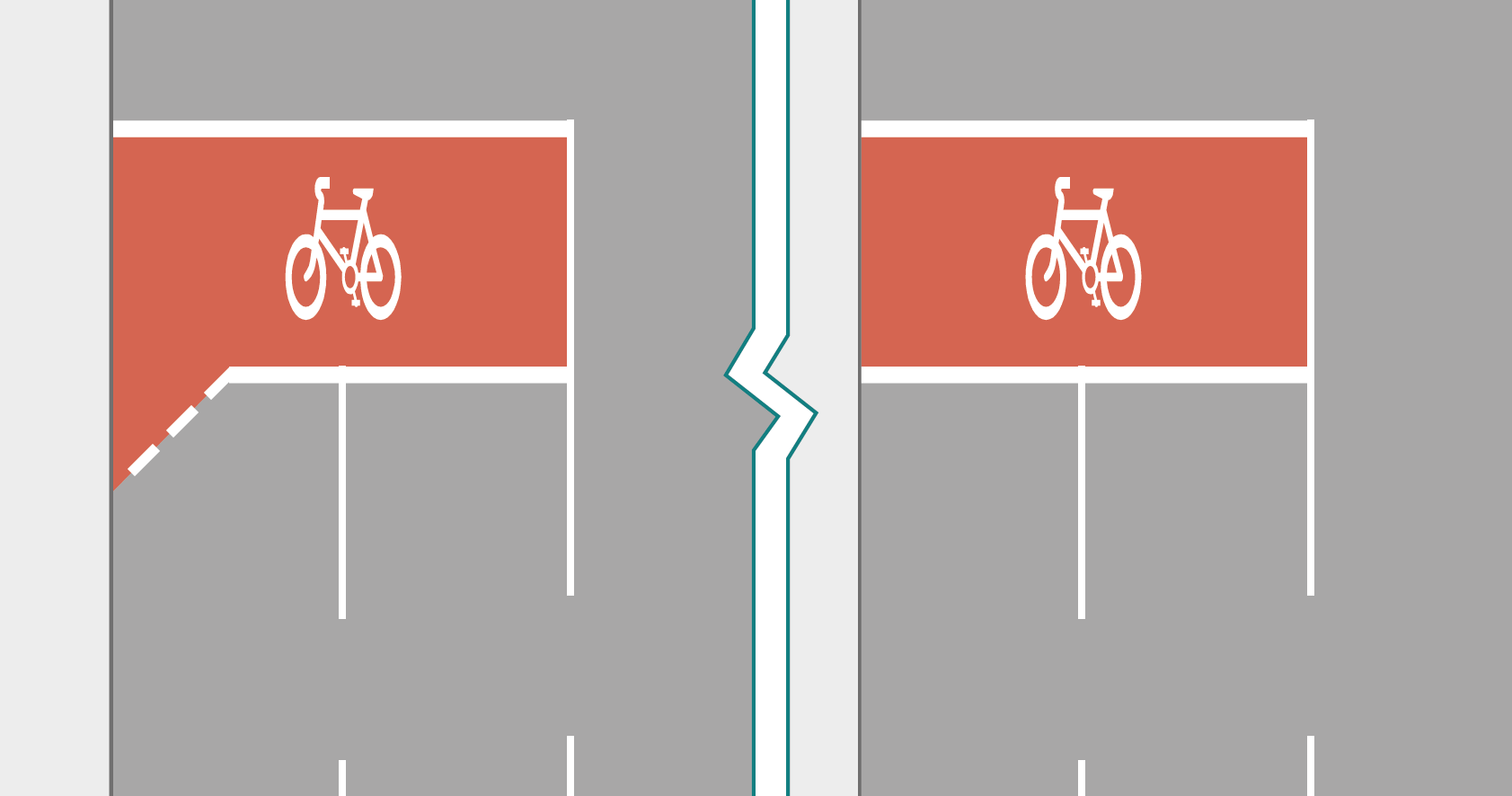
ASLs may include a diagonal ‘gate’ marking TSGRD Diagram 1001.2A to indicate a point of entry to cycle users, or neither an approach lane or ‘gate’ TSGRD Diagram 1001.2B.
ASLs require judgement by the cycle user, as the timing of their approach to the junction relative to the signal phasing is important. This could mean it is difficult for cycle users to establish an appropriate position, or they could find themselves in the ‘blind spot’ of a left- turning vehicle. Cycle users who are lower to the ground may also be less likely to be seen from vehicles waiting behind and to the side.
ASLs should normally extend across all the traffic lanes, though in limited circumstances part-width ASLs may be appropriate. Situations where part-width lanes can be considered include:
- Where right-turn manoeuvres are not permitted (for cycle users or all vehicles)
- There are multiple right-turning lanes
- Vehicle movements into the arm of the junction would encroach into a full-width ASL reservoir
- A nearside traffic lane is controlled by a left-turn filter signal.
| Clause Number | Description |
|---|---|
| 5.3.19 |
A central approach lane, where used, should have an absolute minimum width of 2.0 m and be advisory. Note: Approach lanes can place cycle users in a vulnerable position. |
| 5.3.20 | Where there are filter arrows for left or right-turning traffic, waiting cycle users should not be put in a position where they obstruct vehicular traffic moving when the filter lane is active. |
| 5.3.21 |
The cycle reservoir should be between 4.0 m and 7.5 m deep. Note: If the reservoir is shallow, cycle users can feel intimidated by the proximity of motor vehicles, and cycle users who are lower to the ground may be less visible by following motor vehicles. |
| 5.3.22 | The ASL reservoir should be coloured to discourage motor vehicle encroachment. |
Signal heads for cycle users
TSRGD prescribes two types of signal head to control cycle user traffic.
TSRGD Diagram 3000.2 is sometimes referred to as high level cycle signals (HLCS) and is used to control cycle user only movements on a protected cycle track or approach to a junction.
TSRGD Diagram 3000.2A is sometimes referred to as low level cycle signals (LLCS) and is generally used:
- As a primary signal for protected cycle only movements
- As repeater signals mounted at cycle users’ eye-level on the same pole as traffic signals
- As repeater signals mounted at cycle users’ eye-level on the same pole as full-size cycle signals
- For early release where the cycle user signal gains right of way before an associated signal for motor traffic, mounted on the same pole as full-size signals. In this scenario, low-level cycle signals are generally used with an ASL, allowing cycle users to position themselves in front of the motor traffic queue.
An example of HLCS and LLCS are illustrated in Figure 5.19 and Figure 5.20 respectively.
| Clause Number | Description |
|---|---|
| 5.3.23 | A minimum horizontal clearance of 450 mm should be provided between the edge of the road and a HLCS or LLCS. |
| 5.3.24 | A minimum horizontal clearance of 250 mm should be provided between the edge of the cycle track and a HLCS or LLCS but should be determined on a site-specific basis. |
| 5.3.25 | Any island that accommodates a HLCS alone should be a minimum of 1.05 m or 1.15 m wide depending on the signal head width. |
| 5.3.26 | Any island that accommodates a LLCS alone should be a minimum of 810 mm or 860 mm wide depending on the signal head width. |
| 5.3.27 | Any island that accommodates a LLCS mounted on a signal pole with a high-level general traffic signal should be a minimum of 1.05 m or 1.15 m wide depending on the signal head width. |
| 5.3.28 | A primary LLCS should be 1.2 m from the stop line. It is usually aligned at 45 degrees to the stop line, though shallower angle may be considered for protected lanes/tracks in order to avoid see-through problems and account for other site-specific conditions. |
| 5.3.29 | A secondary LLCS should be aligned to a point in the middle of the carriageway or cycle lane/track and 2.0 m upstream of the stop line. It should be within a 30-degree offset of the middle of the lane. |
| 5.3.30 | Secondary HLCS should be considered where there is a risk for approaching cycle users of poor visibility of low-level signals due to layout constraints or high levels of demand. |
| 5.3.31 | Visibility to the signals should be achievable from an eye height of 0.4 m to accommodate handcycles. |


Roundabouts
The way cycle users are accommodated at roundabouts will depend on several factors relating to layout, volume and composition of traffic. Roundabouts vary in scale – from mini roundabouts to large roundabouts catering for complex traffic patterns.
As with other junction types, protection of cycle users by physical means is generally preferred as it provides a safer and more attractive facility for users. Designers need to take all safety and comfort implications into consideration and provide off-carriageway cycle user facilities where appropriate and feasible. Cycle lanes on the outside of the circulatory carriageway should not be used, even on compact and mini roundabouts. Cycle lanes offer no physical protection and cycle users are vulnerable to ‘left hook’ collisions when motor vehicles are exiting the junction.
Some situations may occur at smaller, compact or mini roundabouts in very low trafficked and low speed environments, where cycle users are able to comfortably use the carriageway. This will only be the case where the conditions for cycle users mixing with motor traffic are met (see Chapter 3).
Where this is the case and cycle users are not protected from circulating traffic, designers should seek to ensure that:
- Approach arm traffic speeds are low
- Circulatory carriageway speeds are low
- Cycle users are positioned prominently and are highly visible both on the approach arms and the circulatory carriageway.
These factors are a function of the geometric design parameters and of the nature of the traffic environment. However, designers need to take all safety and comfort implications into consideration and provide protected cycle facilities at roundabouts as the first choice in most cases. While this section provides guidance for different types of roundabout, each solution will be site specific.
Reference should also be made to the relevant roads authority’s design guidance for roundabouts.
Protected cycle track roundabout layout
The first consideration for most roundabouts will be to separate cycle users from circulating traffic to offer an alternative and safer route through the junction. It is imperative to minimise any additional delay or distance for cycle users and pedestrians.
Separation is achieved by providing a one-way circulatory cycle track around the roundabout and suitably designed crossings of each arm.
The example layout presented in Figure 5.21 incorporates:
- A roundabout with a circulating cycle track and adjacent footway
- A controlled Parallel crossing for cycle users and pedestrians
- A two-way road forming the ‘western’ arm of the roundabout, with one-way cycle tracks on each side and adjacent footway.
Intervisibility between the circulatory road carriageway and the circulating cycle track is necessary to ensure that drivers and cycle users are aware of each other’s presence as they approach the crossing points. The crossing should be visible to the driver. Continuous coloured surfacing across a Parallel crossing may be considered where appropriate, but it is essential that cycle users understand that they do not have priority over other traffic until they are on the crossing.
The form of crossing may vary. The volume of users may justify cycle priority crossings or signal-controlled crossing points, although signal-controlled crossing will potentially result in longer circulatory routes for cycle users and pedestrians and cycle priority crossings will likely require pedestrian crossings to deviate from the pedestrian desire line.
It is essential that motor traffic speeds exiting the roundabout are not excessive and that drivers are able to react to the crossing. Therefore, exit radii from the roundabout should be limited.

| Clause Number | Description |
|---|---|
| 5.4.1 | The minimum length between the edge of the roundabout and the crossing location should be 5.0 m but should avoid excessive detours for cycle users and pedestrians. |
| 5.4.2 | Drivers approaching a roundabout with a Parallel crossing should be able to see the full width of the crossing from a distance at least equal to the desirable minimum stopping sight distance (SSD) for the design speed of the roundabout approach. |
| 5.4.3 | Drivers exiting the circulatory carriageway of the roundabout should have full visibility of the Parallel crossing including the pedestrian landing areas adjacent to the road. |
| 5.4.4 | Where signal-controlled crossings are provided, these should be located 20.0 m from the edge of the roundabout circulatory carriageway. This helps to ensure drivers are travelling slowly as they approach the crossing and to ensure that cycle users and pedestrians are not forced too far from their desire line. |
| 5.4.5 | Crossings should be at a right angle between cycle users / pedestrians and motor traffic to ensure visibility for all users. |
| 5.4.6 | Landing areas for pedestrians should be included on the roundabout arms between the cycle track and the road carriageway, and on the traffic island. |
| 5.4.7 | The width of the pedestrian landing areas should be a minimum of 2.7 m between kerbs to allow for tactile paving at each crossing point and a space between these. |
| 5.4.8 | At the roundabout give-way line, drivers should be able to see the full width of any pedestrian crossing across the next exit if it is within 20.0 m of the roundabout exit on that arm, including the pedestrian landing areas adjacent to the road. |
| 5.4.9 | A minimum 4.0 m radius should be provided where the approaching cycle track joins the circulating cycle track. |
Compact roundabouts
A compact roundabout, defined in DMRB as a roundabout with a central island of at least 4 m in diameter and an inscribed circle diameter (ICD) of between 28 and 36 m, has single lane entries and exits on each arm, which are arranged in a radial pattern, rather than tangential to the central island. The width of the circulatory carriageway is such that it is not possible for two cars to pass one another and drivers are unlikely to attempt to pass a cycle user.
Therefore, where conditions for cycle users mixing with motor traffic are met (Chapter 3), compact roundabouts can be suitable for on-carriageway cycle users without protected facilities. This is dependent on traffic flow, traffic composition and traffic speed and where mixed traffic is also appropriate on the junction approaches.
Mini roundabouts
Mini roundabouts, defined in DMRB as a roundabout where the central island is not kerbed and with an ICD not exceeding 28 m, feature a one-lane circulatory carriageway around a small flush or domed circular island represented by a solid white road marking. They do not feature a physical kerbed island. All road approaches to a mini roundabout are single lane.
Well-designed mini roundabouts that have high levels of driver compliance and entry arm give-way markings can reduce traffic approach speeds as part of traffic calming schemes. Therefore, where conditions for cycle users mixing with motor traffic on approach to the junction are met (Chapter 3), mini roundabouts can be suitable for on-carriageway cycle users without protected facilities. Mini roundabouts can make right turns easier for cycle users than a standard priority junction layout.
Signal-controlled roundabouts
While signalisation of a roundabout can improve traffic operation generally, it is likely that motor traffic on entering and exiting the circulatory carriageway will continue to pose a safety problem for cycle users. Designers should investigate the feasibility of offering cycle users an alternative route away from the general traffic circulatory carriageway, including grade separated provision.
However, a signal-controlled roundabout can benefit cycle users when additional cycle user measures are included, e.g. separate staging, cycle gates or other means to facilitate cycle movement through the roundabout. It can also provide an opportunity to provide pedestrian crossing facilities.
When providing for cycle users at-grade, one of the following approaches may be used at signal-controlled roundabouts:
- Provide facilities on-carriageway at the signalised nodes, so that cycle users are protected from motor traffic e.g. using a hold the left turn arrangement. An example is illustrated in Figure 5.22. ASLs will not create the conditions to enable most users to navigate a signal-controlled roundabout
- Provide a cycle track around the junction with signal-controlled crossings of the roundabout entries and exits as part of the overall junction control. An example is illustrated in Figure 5.23
- A cycle track across or around the roundabout central island with appropriate signal-controlled crossings of the circulatory carriageway and the roundabout entries and exists, particularly on larger roundabouts where a more direct route is required or potentially beneficial to connect a single cycle route.
Where needed, designers are encouraged to use the Design Review process outlined in Chapter 2 and seek approval from the relevant Overseeing Organisation when developing complex roundabout layouts.


Other junction features
A variety of other features can be provided at junctions to facilitate their use by cycle users. Such measures can be considered where a new junction is being developed, or for incorporation at an existing junction to improve cycling facilities.
Cycle user transition / jug handle layout
This scenario can be used where cycle users travelling on a cycle track parallel to a road, an on-carriageway cycle lane or on the carriageway, wish to turn to cross the carriageway. The facility provides a transition for cycle users, removing the need to make an acute right turn from the cycle track or cycle lane, or to wait in the centre of the carriageway. The jug handle allows users to remain in a dedicated facility in advance of making the crossing manoeuvre, potentially improving comfort and safety for users.
A jug handle layout can be used in conjunction with various crossing types, although is likely to be most applicable at crossings within a junction. The example layout presented in Figure 5.24 represents a jug handle layout incorporating:
- A main road with a parallel cycle track and adjacent footway
- A jug handle facility
- A signal-controlled cycle user crossing.
Footway width requirements in accordance with Chapter 3 should be maintained adjacent to the jug handle.

| Clause Number | Description |
|---|---|
| 5.5.1 | A desirable minimum radius of 6.0 m should be provided on the inside edge of the jug handle element. |
| 5.5.2 | The inside edge of the jug handle element may be reduced to an absolute minimum radius of 4.0 m where space is limited. |
Cycle bypass layout
A cycle bypass facility is a junction treatment to improve cycle user comfort and enable cycle users to maintain momentum while other vehicles are held. It is commonly appropriate where traffic is subject to a give way or stop line, or to increase permeability for cycle track users at a junction where a left turn or all movements are prohibited for motor traffic.
The layout can often be challenging to integrate with pedestrian crossing facilities, and it is essential that the provision of a cycle bypass does not reduce pedestrian comfort levels. Any pedestrian crossing of a cycle bypass should be placed on the pedestrian desire line for the approach to and from the crossing points of the road carriageway.
Visibility requirements at the crossing point and at the end of the bypass should be in accordance with Chapter 4. A cycle bypass should discharge into a cycle lane or track. A typical layout is illustrated in Figure 5.25.
Footrests
Footrests at signal-controlled junctions and crossings, or other locations where cycle users need to stop and wait, can assist cycle users in proceeding with their journey. These can be integrated with a handrail for cycle users to hold rather than putting their foot down, which is particularly useful for those using toe clips or clipless pedals.