Trip end facilities
Principles
The core design principles of safety, coherence, directness, comfort, attractiveness and adaptability apply equally to the facilities that a cycle user experiences at the beginning and end of their cycle journey, as they do to the infrastructure that they experience on the journey itself.
The attractiveness of a well planned and maintained cycle network could be undermined if adequate facilities are not available for the parking, storage and maintenance of users’ cycles at their journey origins and destinations.
This chapter provides guidance for the design of cycle parking facilities and sets out the success factors for other end-of-trip facilities.
Cycle parking
As well as serving a functional purpose, the provision of carefully planned, well located, frequent and secure cycle parking facilities can help promote cycle use by making them a prominent part of the street or road environment. Well-designed parking with enough capacity and appropriate circulatory space reduces the clutter of cycles chained to other forms of street furniture, which can affect accessibility for all users of the street.
User requirements
When planning cycle parking, careful consideration should be given to the requirements of those who are using the facility and how their needs can be met. The basic user requirements are set out below, which apply to all types of cycle parking, regardless of duration.
Easy to use: Adequate space in the parking area to facilitate easy manoeuvring without catching other cycles as well as adequate provision of locking points to accommodate different types of cycle.
Accessible: Convenient, visible and prominently located near entrances, at other trip end destinations and throughout the network to encourage the maximum number of users. Provision for ‘non-standard’ cycle vehicles should also be made.
Safe: Located in areas that are naturally overlooked by the occupants of buildings or pedestrians, lit (essential for personal security when parking at night), secure and vandal proof, ideally with suitable CCTV or other security arrangement.
Suitable: Fit for purpose, i.e., appropriate type of facility and number of spaces that serve the needs of the users and the local land use.
Attractive: Sympathetic to the wider environment to enhance its appearance, appropriate to the surrounding area and complementary to surrounding street furniture.
Coherent: Sits within the context of a cycle route network connecting main origins and destinations, including public transport nodes. Cycle parking with no or poor connecting routes may suppress demand.
Well managed and maintained: Efficient to use, clean and free from damaged or abandoned cycles.
Durable: A robust design, constructed with appropriate materials and fixings, that will minimise the whole life cost of cycle parking provision and deter thieves.
In addition to these basic requirements, it is important to consider the specific needs of users for the area where parking is being implemented. These include the journey origins / destinations served by the parking facility, how long cycle users are likely to use the facility and what type of parking facility will best suit these needs.
Short stay parking will be needed close to buildings and other facilities that attract visitors for 2 hours or less. They are likely to attract a high turnover of spaces. These facilities should be located close to building entrances or other facilities such as bus stops. This has benefits including:
- minimising delay to cycle users
- encouraging new users
- enhanced security through visibility and passing footfall.
Medium stay parking will be needed at facilities that attract visitors for up to 12 hours, for example at health and recreational facilities, places of work, education and transport interchanges. Parking should be conveniently located close to the entrance to these facilities but may also need additional security or shelter to be attractive to these users.
Longer stay parking will be needed at places of work, in residential areas and at public transport interchanges and stops. Well-located, covered and secure parking facilities will meet the needs of these users.
| Origin or destination and user | Short stay (less than 2 hours) with stands and wall loops | Medium stay (2 to 12 hours) with stands, store or locker | Long stay (more than 12 hours) with store, locker or hangar |
|---|---|---|---|
| Place of work - employee | Not appropriate | Appropriate | Appropriate |
| Place of work - visitor | Appropriate | Not appropriate | Not appropriate |
| Shopping - employee | Not appropriate | Appropriate | Appropriate |
| Shopping - visitor | Appropriate | Not appropriate | Not appropriate |
| Education - student or teacher | Not appropriate | Appropriate | Appropriate |
| Education - visitor | Appropriate | Not appropriate | Not appropriate |
| Residential - resident | Not appropriate | Not appropriate | Appropriate |
| Residential - visitor | Appropriate | Not appropriate | Not appropriate |
| Recreational or leisure - all users | Not appropriate | Appropriate | Appropriate |
| Health - employee | Not appropriate | Not appropriate | Appropriate |
| Health - visitor | Not appropriate | Appropriate | Not appropriate |
| Transport interchanges and stops - all users | Appropriate | Appropriate | Appropriate |
Demand and capacity requirements
Successful cycle parking requires to be considered as part of the transportation aspects of development management and built into the early stages of designing new land use developments.
There is also a need to understand the destination of existing cycle demand and to provide suitable cycle parking close to these existing facilities, to fill gaps in the supply of parking on our streets, towns and cities. In assessing the parking demand, this will generally be a function of the land use type and its size, or the proximity of trip generators and attractors, for example:
- Residential properties
- Commercial properties: staff and customers
- Retail facilities and pedestrianised areas: staff and customers
- Educational locations: staff and students
- Train stations: staff and customers
- Bus stations: staff and customers
- Subway stations: staff and customers
- Car club bays: customers
- Cafés: staff and customers
- Religious centres: staff and visitors.
Designers should provide at least the minimum number of cycle parking spaces as required by Local Planning policy for all new developments, and when retrofitting parking to existing streets.
When determining the demand for the number of parking spaces above the minimum requirements set by Local Planning policy, consideration can be given to the following information sources:
- Counts and surveys – cycle surveys that have assessed the provision of and the demand for cycle parking at different times of the day and year to understand variations of use
- Modal split data – provides a guide of cycling levels within an area and can be used in combination with a broad assessment of likely demand for cycling, based on key attractors and their catchment areas
- Demographic data – consideration of the catchment population of an area, again used in combination with an understanding of the key destinations that will attract cycle trips
- Latent demand – as a minimum, cycle parking provision may reflect targets for growth in cycling. These targets may be part of a Local Transport Strategy, Travel Plan or on-site assessment
- Temporary trials – data can be gathered using temporary cycle parking associated with events or where authorities believe there may be a greater demand for cycling, without the cost of full implementation until trials are complete.
Level of Service Indicators – Cycle Parking
In relation to Design Principle – Safety
- High Level of Service: Secure, overlooked, well-lit and exceeds the desirable minimum level of provision
- Medium Level of Service: Secure but not overlooked and/or only providing the desirable minimum level of provision
- Low Level of Service: Not secure and below the desirable minimum level of provision
In relation to Design Principle – Adaptability
- High Level of Service: Has the flexibility to expand, evolve or adapt to changing demands
- Medium Level of Service: Has only limited flexibility to expand, evolve or adapt to changing demands
- Low Level of Service: Has no scope to expand, evolve or adapt to changing demands once installed
Design
General considerations
The layout of cycle parking is important to ensure that all users, including those with mobility impairments, can access the facilities. A clear route to cycle stands, not blocked by parked vehicles or street furniture, will help to achieve this. Specific layout requirements are described for each type of parking facility on the following pages.
The following types of cycle parking are considered:
- Sheffield Stands and M-profile Stands
- Two-tier Stands
- Cycle Hangars
- Wall Loops
- Cycle Stores
- Horizontal Cycle Lockers.
| Clause Number | Description |
|---|---|
| 6.2.1 | Cycle stands which only grip the cycle by a wheel (including butterfly racks and concrete slots) should not be installed as they offer only limited security, can cause a trip hazard to pedestrians and can damage wheel rims. |
| 6.2.2 | Any cycle parking facility should allow for the frame and both wheels to be locked to the fixture. A minimum of two points of contact is recommended and some flexibility in the design of cycle parking stands to suit local conditions may be considered, but all facilities should fulfil the main function of allowing for two-point frame and wheel locking. |
| 6.2.3 | As with any street furniture, sharp corners and other hazards should be designed out. |
| 6.2.4 | Cycle parking should be designed and located to ensure that it does not represent a barrier to access for other users of the street. This will require enough space for all users to pass and circulate around the cycle parking facility with cycles in place. |
| 6.2.5 | Where necessary, dropped kerbs should be provided for users to access cycle parking facilities from the cycle track or road carriageway. |
| 6.2.6 | Provision for 'non-standard' cycle vehicles should be provided at each parking facility, usually by allowing these cycles to be parked at the end of a row of cycle stands. Clear signage directing users to these areas should be provided and a different coloured surfacing may be useful to differentiate these spaces from other general cycle parking. |
| 6.2.7 | For personal security and practical purposes, cycle parking should be appropriately illuminated and may be done so independently or may be achieved by adjacent street lighting. Cycle parking placed in dark recesses will not be attractive or secure. |
| 6.2.8 | Resident cycle parking should be located internally. Communal provision should be accessed via a secure entrance that is well lit and overlooked. |
| 6.2.9 | Where long stay cycle parking cannot be provided internally, the Planning Authority should consider a financial contribution to assist the developer or building owner in providing more long stay cycle parking, for example, Cycle Hangars conveniently located on the street. |
| 6.2.10 | Cycle parking should be appropriately coloured/tonally contrasted to the surrounding area to assist blind and partially sighted users and pedestrians navigating the adjacent space. Reference should be made to Roads for All: Good Practice Guide for Roads for additional information relating to the colour and conspicuousness of street furniture. |
Sheffield stand and M-profile stand
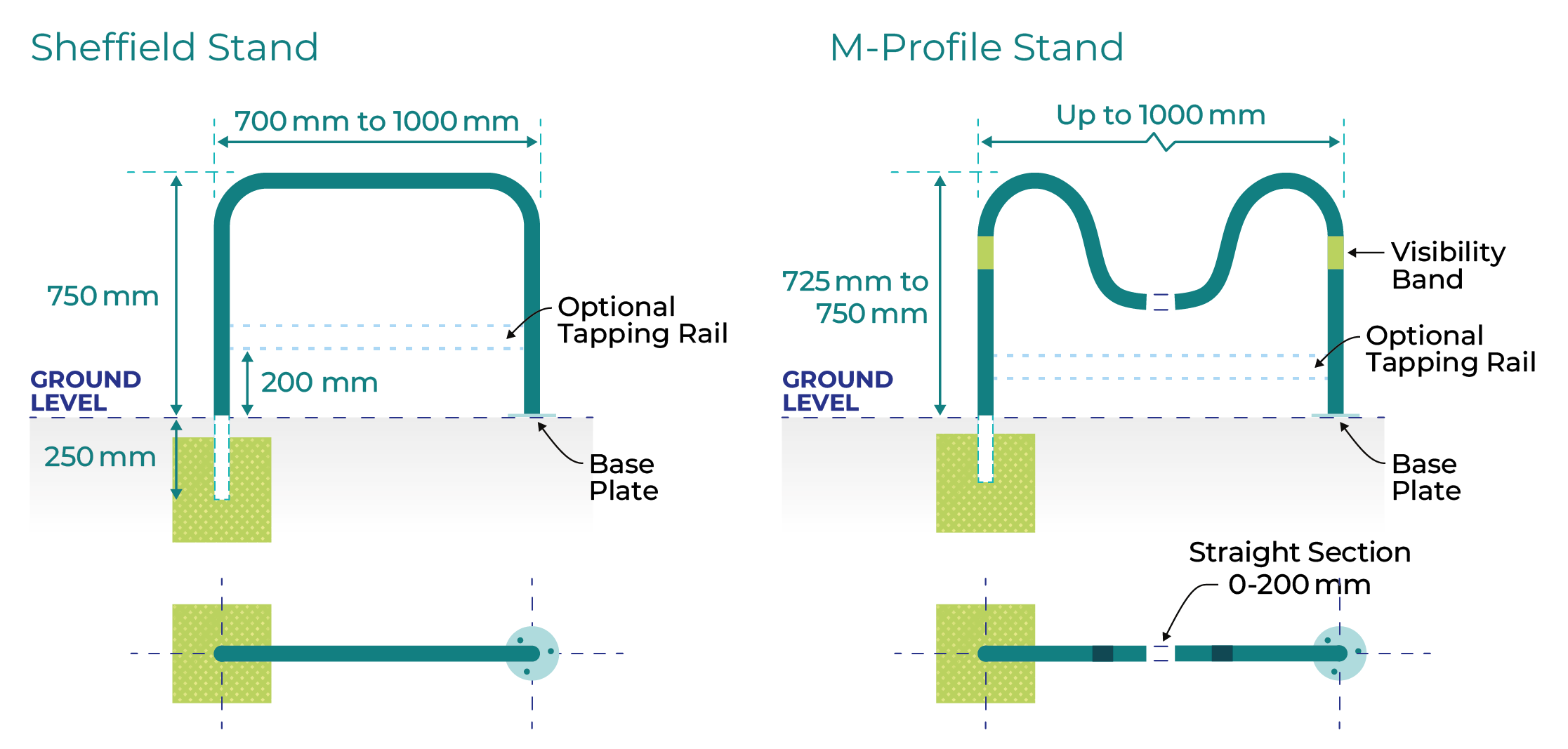
Sheffield stands are the most used facility for short stay cycle parking, although they can be used on-street or in combination with shelters and other facilities for longer stay parking. M-profile stands provide an alternative profile to Sheffield stands, and both have been designed specifically to allow cycles to be locked at multiple points.
A typical Sheffield stand and a typical M-profile stand, intended for full size cycles, are illustrated in Figure 6.1.
When used on-street, it is preferable for Sheffield stands and M-profile stands to be located on space that is reallocated from the road carriageway, before consideration is given to locating stands on the footway.
In all situations, local restrictions and considerations will influence the location of parking. These include ensuring that pedestrian desire lines are not blocked, that access is maintained for kerbside delivery to adjacent properties where this is needed, and that access is maintained for underground utility maintenance. In situations where the erection of a cycle stand could create a potential injury risk to other users, such as to children in a school playground, a physical barrier (such as a shelter) to separate the cycle stand from those at risk may be installed.
Designers should provide a more favourable location for cycle parking over the parking of private cars, and in frequent, small groups where gaps will allow ‘non-standard’ cycle vehicles to be secured to outside stands. Conveniently located parking can be achieved by replacing on-street car parking spaces with cycle parking stands and ensuring stands are located in prominent locations near entrances to major trip attractors and generators, as close to user destinations as possible.
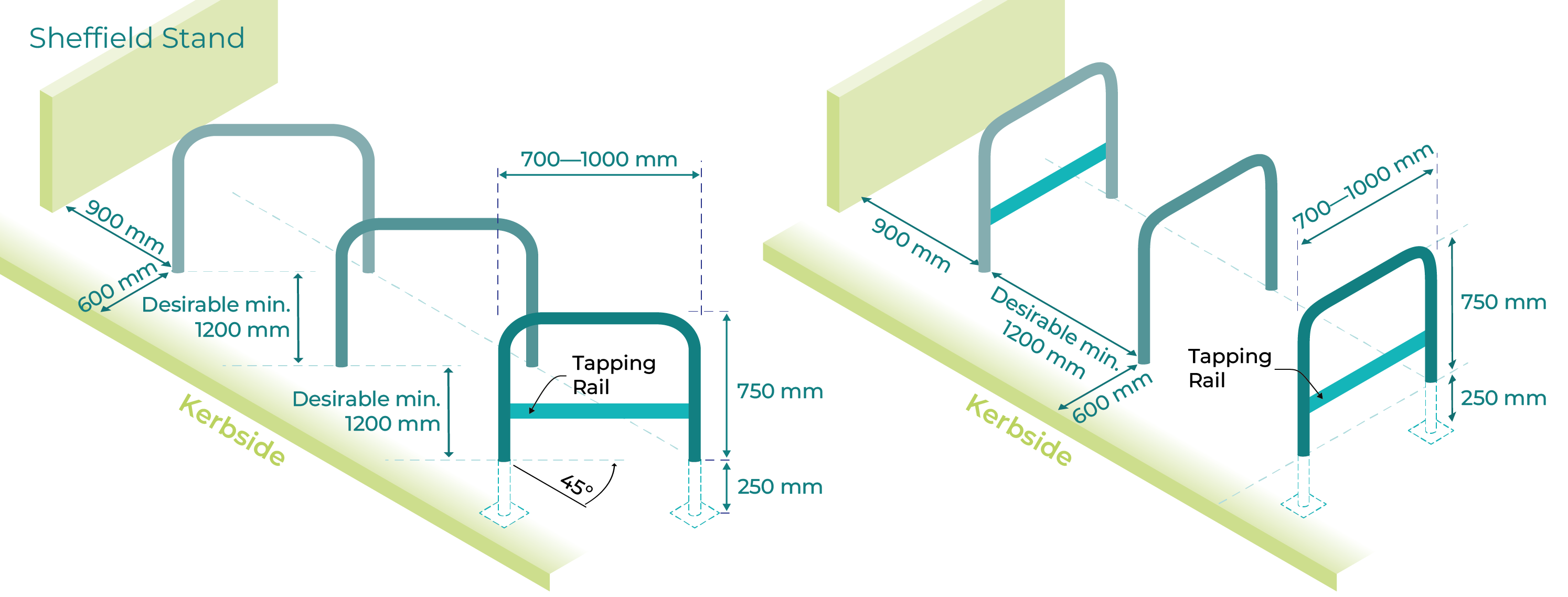
However, where Sheffield stands or M-profile stands are located on the footway, these should be located where it is unlikely to cause obstruction to pedestrians and where a minimum clear footway width of 2.0 m can be maintained (although this may have to be wider in a busy area). Additionally, cycle stands could be installed on a paving material with a different surface texture or colour to the surrounding footway to differentiate it from the footway. Potential on-street Sheffield stand layouts are illustrated in Figure 6.2.
Covered Sheffield or M-profile stands with open access may be appropriate at relatively small transport interchanges to protect cycles from the weather where users require flexibility in travel choice, which suit both the occasional and regular user. Ideally these would have clear transparent sides. Note, Horizontal Cycle Lockers may also supplement this type of provision at transport interchanges.
The advantages of Sheffield or M-profile stands include that they:
- Are cost effective, extremely adaptable and easy to use and understand by cycle users
- Can be designed and positioned to fit into the surrounding environment
- Can be designed and positioned to accommodate non-standard cycles
- Are accessible from both ends and allow two cycles to be locked to the stand if installed correctly
- Can lock both wheels.
The disadvantages of Sheffield or M-profile stands include that they:
- Are prone to vandalism
- Depending on shelter, can be open to weather
- While each stand is designed to accommodate two standard cycles, this can lead to a clashing of pedals and/or handlebars, and extra difficulty in locking the bike.
Design requirements for Sheffield and M-profile stands are set out below.
| Clause Number | Description |
|---|---|
| 6.2.11 | The spacing between Sheffield stands or M-profile stands that are in line should be a minimum of 2,500 mm between centres and a minimum clearance of 900 mm from the nearest facility, for example, cycle track or carriageway, or any vertical obstruction. |
| 6.2.12 | The spacing between Sheffield stands or M-profile stands that are parallel to each other should be a minimum of 1,200 mm. The minimum clearance from the nearest parallel facility should be 900 mm and the minimum clearance from the nearest perpendicular facility should be 600 mm. |
| 6.2.13 | The angled installation of Sheffield stands or M-profile stands should be angled at 45 degrees. |
| 6.2.14 | Sheffield stands or M-profile stands should be well signed, with signs conforming to TSRGD and Traffic Signs Manual, likely to comprise the combination of TSGRD Diagram 968 and TSGRD Diagram 968.1 to denote a 'parking place for pedal cycles'. |
| 6.2.15 | Signage may be put in place that clearly identifies any cycle parking allocated for non-standard cycles, for example, "Reserved for cargo and non-standard cycles. Priority to disabled cyclists". |
| 6.2.16 | A Sheffield stand should be 700-1,000 mm wide. |
| 6.2.17 | An M-profile stand should be up to 1,000 mm wide. |
| 6.2.18 | The height of a Sheffield stand should be 750 mm above ground level. |
| 6.2.19 | At schools, leisure facilities or other similar locations where children may attend, an extra horizontal bar should be provided on Sheffield stands 500 mm above ground level to provide support for children's cycles. |
| 6.2.20 | The height of an M-profile stand should be 725-750 mm above ground level. |
| 6.2.21 | The central straight section of an M-profile stand should be 300-400 mm above ground level. |
| 6.2.22 |
A lone Sheffield or M-profile stand or the end Sheffield or M-profile stands of a group should incorporate a tapping rail 150 mm above ground level, to help prevent people with visual impairments inadvertently colliding with the stands. Its placement is important to its functionality as a visual aid. Note: The tapping rail also serves to provide a closed loop for tethering a cycle that will still hold the cycle even if a leg becomes detached from the ground. |
| 6.2.23 | The tube diameter of Sheffield stands or M-profile stands should be 50-70 mm. |
| 6.2.24 | Sheffield stand or M-profile stand ends may be embedded in concrete (a minimum of 250 mm) or bolted to the surface, individually or collectively welded to parallel bars at ground level to form a 'toast rack' system. |
Two-tier stand
Two-tier stands offer an effective solution for high-capacity medium and long stay cycle parking in areas where space may be constrained. Two-tier stands use a staggered trough system on both upper and lower tiers or can incorporate Sheffield or M-profile stands on the lower tier.
A typical Two-tier stand layout, intended for full size cycles, with Sheffield stands on the lower tier is illustrated in Figure 6.3.

It is important that Two-tier stands are situated in prominent locations near entrances to major attractions and as close to the destination point as possible. They should be located only where they do not cause a hazard to other users and only where a minimum clear footway width of 2.0 m can be maintained, or where the appropriate operating space can be provided when located off-street.
The upper tier troughs employ an easy to use ‘pull down-push up’ top loading mechanism that is either spring loaded or gas-assisted. The upper tier troughs should also feature a safety catch securing the upper trough in position once loaded and hi-visibility handles.
The advantages of Two-tier stands include:
- Staggered troughs allow for handlebars to avoid clashing and enable easy operation
- If used, two cycles can be locked to Sheffield or M-profile stands on the bottom tier and these provide the advantage of familiarity and easier maintenance.
The disadvantages of Two-tier stands include:
- The top tier can be less easy to operate for some users
- Generally, not suitable for heavy cycles or those with child seat, baskets or panniers
- Not suitable for non-standard cycles such as tricycles or cargo bikes
- Additional maintenance burden due to requirement for moving parts
- May not fit in buildings or basement parking areas with limited ceiling heights.
Design requirements for Two-tier stands are set out below.
| Clause Number | Description |
|---|---|
| 6.2.25 | The spacing of troughs on Two-tier stands should be a minimum of 400 mm. |
| 6.2.26 | A minimum aisle width of 2,500 mm should be provided beyond the lowered frame of Two-tier stands to allow cycles to be turned and loaded, although further guidance should be sought from the manufacturer/supplier. |
| 6.2.27 | The minimum aisle width beyond the lowered frames of Two-tier stands should be increased to 3,500 mm where there are racks on either side of the aisle. |
| 6.2.28 | Two-tier stands should be well signed, with signs provided conforming to TSRGD and Traffic Signs Manual, likely to comprise the combination of TSGRD Diagram 968 and TSGRD Diagram 968.1 to denote a 'parking place for pedal cycles'. |
| 6.2.29 | A Two-tier stand will require a height of at least 2,700 mm. |
| 6.2.30 | Two-tier stand ends should be bolted to the surface. |
Cycle Hangars
While best practice would be to provide dedicated long stay cycle parking in a secure, covered and lockable enclosure, preferably within the footprint of the building within new developments, the lack of internal cycle storage in existing residences and commercial buildings can lead to the scenario where internal circulatory spaces and stairwells can be blocked.
In areas where existing buildings are accessed by steps or have no space for outside storage, on-street cycle parking may be more practical. The provision of standard on-street parking, for example, Sheffield stands, may present problems of security and exposure to the elements, deterring the uptake of cycling by residents or staff and customers.
Therefore, to encourage more cycle use, Cycle Hangars, generally accommodating six cycles, can be installed to provide a dedicated place to park securely outside the curtilage of an existing building. These may be located by either reclaiming existing road space used for car parking or in a nearby location with suitable hard standing. Cycle Hangars are normally only available to registered key-holders.
The advantages of Cycle Hangars include that they:
- Are weatherproof and reduce the anxiety of potential theft
- Can securely accommodate several cycles within less space than a standard on-street parallel parking space, when reclaiming existing road space used for car parking
- Provide space for optional branding which can support or fund their installation
- Can be customised to suit demand.
The disadvantages of Cycle Hangars include that they:
- May not be accessible to non-standard cycles and users of cycles as mobility aids unless designed with adequate space
- May require residents to rent a space or spaces from the Local Authority.
Cycle Hangar dimensions can vary depending on the manufacturer. However, approximate dimensions to provide safe and dry storage space for up to six standard cycle vehicles are a width of 2,500 mm, a length of 2,000 mm, and a height of 1,400 mm.
Wall Loop
A Wall Loop offers one point of contact for cycle locking and is therefore less preferable to the other short stay parking facilities. However, they can provide a parking solution where space is very constrained and may be more appropriate in areas where footway widths are restricted. Wall Loops may be a useful additional facility to supplement Sheffield or M-profile Stands in areas heavily used by cycle users for short stay parking.
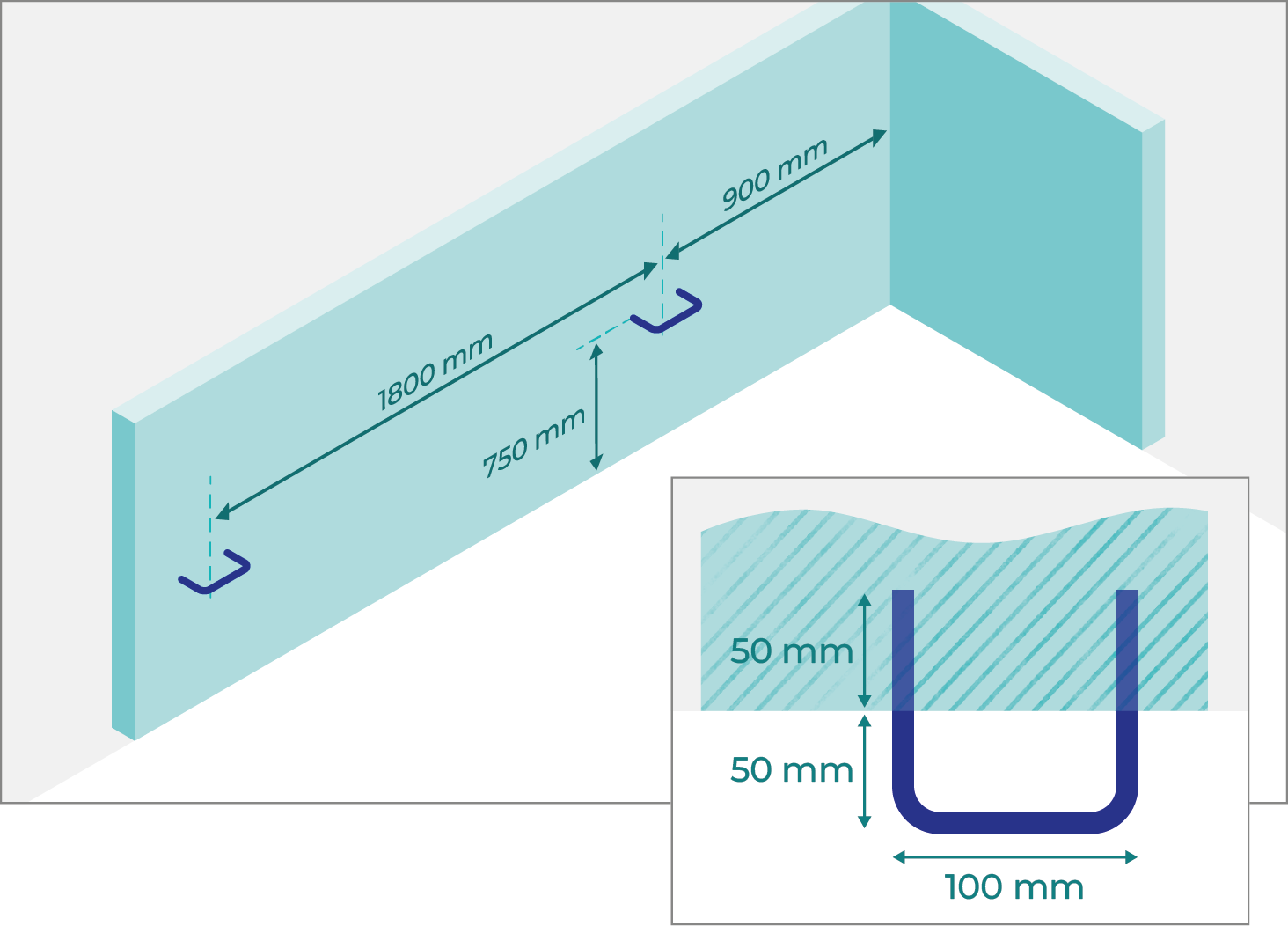
A typical Wall Loop layout, intended for standard cycles, is illustrated in Figure 6.4.
Wall Loops may generally be provided for short to medium stay parking scenarios as a solution where there is limited space. As with other forms of cycle parking, Wall Loops should be situated in prominent locations near entrances to major attractions and as close to destinations as possible. Likewise, locating Wall Loops adjacent to the footway should only be considered where they are unlikely to cause obstruction to pedestrians.
The advantages of Wall Loops include that they:
- Are simple, relatively inexpensive and useful where footway widths are restricted
- Can be used to supplement Sheffield stands or M-profile stands in heavily used areas for short stay parking
- Will avoid clashing of pedals and/or handlebars.
The disadvantages of Wall Loops include that they can be:
- Less secure – standard locking chain will not fit around both cycle wheels and frame, and the loop
- May not be suitable for some non-standard cycles.
Design requirements for Wall Loops are set out below.
| Clause Number | Description |
|---|---|
| 6.2.31 | The spacing between Wall Loops should be 1,800 mm between centres and a minimum of 900 mm from the nearest wall or other vertical obstruction. |
| 6.2.32 | Wall Loops should be well signed, with signs provided conforming to TSRGD and Traffic Signs Manual, likely to comprise the combination of TSRGD Diagram 968 and TSRGD Diagram 968.1 to denote a 'parking place for pedal cycles'. |
| 6.2.33 | Wall Loops should be 100 mm wide. |
| 6.2.34 | Wall Loops should be 750 mm above ground level. |
| 6.2.35 | Wall Loops should protrude no more than 50 mm from the wall. |
| 6.2.36 | Wall Loops should be embedded a minimum of 50 mm into the wall. |
Cycle Store
A Cycle Store provides a sheltered and secure location with multiple cycle stands. These provide an additional level of shelter and security for users wishing to park their cycles for more than short stay visits.
A typical Cycle Store layout, intended for full size cycles, is illustrated in Figure 6.5.

A Cycle Store may be under continuous supervision or have a shared key arrangement where each cycle user has a key to the outer door or gate. They may include Sheffield or M-profile Stands internally to individually secure cycles or include the use of two-tier stands. As with other parking types, a Cycle Store should be well lit for personal security and practical purposes.
The advantages of Cycle Stores include that they:
- Are weatherproof and reduce the anxiety of potential theft
- Allow cycle users to keep supplementary equipment, such as lights, attached to the cycle.
The disadvantages of Cycle Stores include that they:
- Are more expensive, require more space and maintenance
- Require adequate management arrangements to be in place to maximise their use, provide maintenance and reduce misuse
- May not be accessible to non-standard cycles and users of cycles as mobility aids unless designed with adequate space.
Design requirements for Cycle Stores to accommodate standard cycle vehicles are set out below. Extra space should be provided when accommodating non-standard cycles.
| Clause Number | Description |
|---|---|
| 6.2.37 | The perpendicular spacing of Sheffield of M-profile Stands should be a minimum of 1,200 mm, including when part of a two-tier stand layout, and a minimum of 900 mm from the boundary wall or fence of the Cycle Store. |
| 6.2.38 | The ends of Sheffield or M-profile Stands should be a minimum of 600 mm from the boundary wall or fence of the Cycle Store and from the access aisle separating groups of stands. |
| 6.2.39 | The access aisle width separating groups of stands should be 2,500 mm, but may be a minimum of 1,800 mm for Sheffield or M-profile Stands. The minimum aisle width for Two-tier Stands should follow the guidance provided previously. |
| 6.2.40 | Cycle Stores should be well signed, with signs provided conforming to TSRGD and Traffic Signs Manual, likely to comprise the combination of TSRGD Diagram 968 and TSRGD Diagram 968.1 to denote a 'parking place for pedal cycles'. |
| 6.2.41 | Signage may be put in place that clearly denotes cycle parking allocated for non-standard cycles, for example, "Reserved for cargo and non-standard cycles. Priority to disabled cyclists". |
| 6.2.42 | If access for cycle users is located behind a door or gate, a minimum width of 1,000 mm for moving the cycle through the space should be provided. Any door or gate should be easy to use and have a delayed automatic closer to allow cycle users to pass through in good time. |
More innovative solutions also exist that incorporate green-roofed cycle shelters, which can provide habitats for birds and insects, as well acting as a climate change adaptation technique by absorbing rainfall and mitigating against flooding.
Horizontal Cycle Locker
Horizontal Cycle Lockers offer alternative secure cycle storage in areas where Cycle Stores cannot be accommodated.
A typical Horizontal Cycle Locker layout, intended for full size cycles, is illustrated in Figure 6.6.

Horizontal Cycle Lockers occupy more space than short stay cycle stands but can provide additional security and protection for cycles at key locations, such as railway stations, where enough space is not available for Cycle Stores. They may be most appropriate in situations where regular users can take ownership of ‘their’ locker to ensure the locker is always kept neat and tidy and locked to prevent key copying and misuse. Alternatively, Horizontal Cycle Lockers may be operated by coin, token, credit card or secured by a cycle lock.
The advantages of Horizontal Cycle Lockers include that they:
- Offer a secure parking facility, allowing accessories to be stored and reducing the anxiety of potential theft, if well managed
- Provide weather protection
- Provide space for optional branding which can support or fund their installation and may also ensure they are in visible locations.
The disadvantages of Horizontal Cycle Lockers include that they:
- Are significantly more expensive than Sheffield or M-profile stands
- Take up space and may be visually intrusive
- Are unsuitable for occasional or short stay use
- Require adequate management arrangements to maximise their use, provide maintenance and reduce misuse
- May not be accessible to non-standard cycles and users of cycles as mobility aids unless designed with adequate space.
Design requirements for Cycle Lockers are set out below.
| Clause Number | Description |
|---|---|
| 6.2.43 | Horizontal Cycle Lockers should be a desirable minimum of 900 mm wide. |
| 6.2.44 | Horizontal Cycle Lockers should be a desirable minimum of 1,900 mm in length. |
| 6.2.45 | Horizontal Cycle Lockers should be a desirable minimum of 1,200 mm in height. |
| 6.2.46 | The access aisle width between opposite lockers should be 2,500 mm, but may be a minimum of 1,800 mm. |
| 6.2.47 | A circulatory aisle width of 1,500 mm should be maintained around the locker/locker units, including from any vertical obstruction, to manoeuvre cycles. |
| 6.2.48 | Horizontal Cycle Lockers should be well signed, with signs provided conforming to TSRGD and Traffic Signs Manual, likely to comprise the combination of TSRGD Diagram 968 and TSRGD Diagram 968.1 to denote a 'parking place for pedal cycles'. |
| 6.2.49 | Signage may be put in place that clearly denotes cycle parking allocated for non-standard cycles, for example, "Reserved for cargo and non-standard cycles. Priority to disabled cyclists". |
| 6.2.50 | If access for cycle users is located behind a door or gate, these should be easy to use and a minimum width of 1000 mm for moving the cycle through the space. Any door or gate should have a delayed automatic closer to allow cycle users to pass through in good time. |
Public transport integration
Importance of integration
The integration of cycling and other forms of transport provides a highly competitive (efficiency, time and cost saving) door to door alternative to the private car for medium to long distance trips. This adds flexibility to commuting journeys and significantly increases the catchment area for public transport relative to that for pedestrians.
People are more likely to cycle if the journey to and from the public transport facility is convenient and there is good, reliable provision of cycle parking or cycle carriage to allow them to continue their journey using public transport. The main types of interchange include:
- Cycle and Ride – Cycling to or from public transport where secure cycle parking is provided. The cycle is left at this location and public transport is used for the remainder of the journey
- Cycle Carriage – Cycling to an interchange point and travelling with the cycle on the public transport service and using it at the other end to continue the journey
- Public Cycle Hire – Utilising cycle hire facilities at the public transport nodes to link journeys.
It is essential that the correct type of cycle parking is based on user needs and duration of stay and supplemented with routes to and from transport interchanges that are highly visible and prioritised. As outlined in Section 6.2, cycle parking at transport interchanges should be fit for purpose, suitably located and visible to promote cycle use ahead of private car use.
As well as public transport, cycling can also be integrated with car club provision.
Cycle and ride
Cycle and Ride facilities should be highly visible formalised parking areas at or near to public transport interchanges. To provide a facility that will be successful, the location of the Cycle and Ride site and the type of facilities to be provided need to be carefully planned to help promote cycle integration.
In order to maximise the use of Cycle and Ride facilities they should be located at sites where:
- The public transport interchange is within convenient cycling distance of travellers’ trip origins, and intercepts known commuting routes
- An integrated journey is more attractive than completing the full trip by cycling. Integrating public transport and cycling should therefore be aimed at medium/ long distance trips
- The journey from trip origin to the Cycle and Ride facility should be safe, convenient and attractive to use.
Cycle carriage
Not all cycle users wish to leave their cycle at the public transport interchange. Some users may require their cycle at the other end of the public transport link for their onward journey, for example, those who use their cycle as a mobility aid.
An understanding of existing and potential cycle carriage capacity on the public transport network is therefore important when planning an integrated cycle network, and engagement with rail and bus operators should be sought.
A variety of systems are used to carry cycles on trains. These include dedicated storage space in carriages with modified seating arrangements, or dedicated carriages such as those due to operate on the West Highland Line (see Figure 6.7).

Where specific carriages or doors should be used for accessing cycle storage, these should be clearly signed, and signs placed consistently at the front and rear of train carriages.
Likewise, a variety of systems are used to carry cycles on buses and include rear mounted racks, in storage areas on longer haul routes, or by providing dedicated storage onboard such as that recently incorporated on a variety of bus services operated by Borders Buses (see Figure 6.8).

Providing information to passengers on how to use cycle carriage facilities will assist with the efficiency of public transport services.
Where cycle storage is provided it should not be at the cost of disabled people’s access or seating. Both facilities should be provided separately where possible, and cycle storage should be designed to enable disabled people’s access.
Public cycle hire
A public cycle hire scheme offers rental or free cycles in urban areas catering for a variety of short trips that can be used for daily mobility, including one-way-use or as part of the public transport system.
Cycle hire schemes are now well established in Scotland and there is clear demand for these schemes within the planning of urban cycle networks, providing access to functional cycles for those looking to make relatively short journeys while ‘dressed for the destination’ rather than the journey itself.
The common successful elements of cycle hire schemes are:
- A dense network of docking stations or virtual docking opportunities
- Stations located close to large trip attractors and connected by a safe, cohesive cycle network
- Flexibility in the offering of manual or electric cycles
- Enough urban space for expansion of cycle stations
- Pricing structure to maximise turnover of use and encourage short trips
- Smartcard and/or credit card payment system
- Strong management of distribution and maintenance.
Implementation and management responsibility for cycle hire schemes has often been through third party contracts and tied to advertising.
The flexibility offered by virtual docking opportunities (where cycles are locked internally by the user when their trip is finished, rather than locking to a fixed docking station) needs to be carefully balanced with the security of both the cycles and the safety of other users of the street.
To determine the appropriate level of provision and the likely infrastructure requirements, designers should consult with the relevant planning authority to consider the estimated demands, location and layout to fit the local circumstances.
Active travel hubs
An Active Travel Hub provides a focal point for cycling and walking routes. The specifics of each Hub are tailored to the location and based upon need but will typically include cycle library initiatives/cycle hire, safe and secure facilities for personal cycles, cycle repair/maintenance facilities, improved links to public transport, local path networks, travel information and associated outreach activity.
Funding is available to support the development of an Active Travel Hub via Transport Scotland’s Low Carbon Travel and Transport Challenge Fund which is administered by the Energy Saving Trust.
An Active Travel Hub should be targeted at increasing the opportunities for walking, cycling and wheeling for functional journeys and connectivity with public transport as well as supporting the uptake of low carbon vehicles. Hubs should aim to house and cater for adapted cycles and other specialist bikes to better address mobility issues experienced by groups such as disabled people and older people.
Furthermore, it is essential they complement any existing infrastructure and are located at convenient, safe and accessible sites in order to maximise use, impact and outcomes. Hubs may be located:
- At park and ride facilities
- At major employment and education centres – schools, colleges, universities
- Close to public transport facilities – ferry terminals, bus stations etc
- Within town centres
- At health and leisure centres
- Close to tenement buildings/flats where on-street charging may be problematic
- In socio-economic disadvantaged areas
- In areas intended to address local air quality problems
- In areas which address geographical travel and transport challenges
- At public sector organisation facilities (i.e. local authority fleets) amenable for general public use.
It is important that hubs address the wide and varied needs of potential users, including catering for mixed mobility needs.
An Active Travel Hub may also be integrated with a Low Carbon Transport Hub, which provide refuelling facilities for a range of alternative fuels and transport modes, for example, electric vehicle charging points, hydrogen refuelling stations and gas refuelling facilities or alternatively a single fuel type.
Other trip-end facilities
People who cycle to workplaces and other popular destinations should be provided with other high-quality end-of-trip facilities, that may include showers, lockers, drying rooms, ironing facilities, bicycle service/repair toolkits, active travel repair stations and e-bike charging facilities. These can be just as important as cycle parking, making it a more attractive option for those amenable to travel by cycle.
Appropriate end-of-trip facilities can be determined as part of the development management process, i.e. assessed by the planning authority prior to a proposed development receiving planning approval, or when planning permission may be required when installing facilities retrospectively to an existing development. For new developments, these elements would likely form part of the supporting Transport Assessment and Travel Plan documents and would consider the potential contribution a development can make to sustainable travel, tailored to the circumstances of the development.
For existing facilities, the Scottish Government and Cycling Scotland offer advice and grants to employers and workplaces so they can develop similar facilities for their locations to encourage staff and visitors to cycle.
A package of co-ordinated measures will be more effective in changing travel patterns than individual initiatives. Also, support and funding for capital projects that encourage staff and visitors to travel by cycle exist that could support the provision of facilities at existing sites.