Carbon reduction on roads
Overview
The Scottish Government committed to phasing out the need for new petrol and diesel vans by 2032 in 2017. The Climate Change Plan update (published December 2020) brought that commitment forward to 2030.
We have invested over £65 million since 2011 to support development of Scotland’s public EV charging network and by population Scotland has one of the most comprehensive public charging networks in the UK.
Our Vision for public EV charging sets out the key areas underpinning a truly world-class, people-focused charging network –working seamlessly wherever you live or need to get to.
We are continuing to invest in public EV charging through the £30 million EV Infrastructure Fund, supporting local authorities to work with the private sector to leverage additional investment and continue to grow public EV charging across Scotland.
To help the public sector lead fleet decarbonisation from the front, we have provided over £80 million to support the public sector to decarbonise its fleet. We have supported this transition by supporting the decarbonisation of cars, vans and a small number of demonstration projects focusing on heavy and specialist vehicles.
We have provided financial support to install charge points at people’s homes and at workplaces, as well as loans for individuals and businesses to support the switch to electric vehicles.
Supporting Scotland’s public EV charging network
Scotland began investing in the charging network in 2011, however estimates from the Scottish Futures Trust state that the private sector invested between £25 million and £35 million in 2023, £40 million and £55 million in 2024, and £50 million to £75 million in 2025. ChargeUK is a trade organisation that represents private sector Charge Point Operators who are investing in public EV charging. Collectively, members of ChargeUK have publicly committed to investing over £6 billion in the UK’s public EV charging network by 2030.
Today, Scotland has over 12,000 EV chargers (March 2026); one of the most comprehensive public charging networks in the UK.
This figure has increased recently due to the UK Department for Transport, and its data provider Zapmap, changing the methodology used for counting public EV charging in February 2026.
Our Vision for public EV charging infrastructure in Scotland was published in June 2023 setting the direction and ambition for the public charging network. Our draft Vision Implementation Plan published in December 2024 set out fifteen actions to enable the delivery on our vision and ambition, largely funded and delivered by the private sector.
Through our £30 million EV Infrastructure Fund, we are continuing to support local authorities to work in partnership with the private sector to expand public EV charging across Scotland, with public funding prioritising those areas of Scotland less likely to benefit from stand-alone private sector investment in public EV charging infrastructure, including rural and island communities.
In 2025/26, an additional £4.5 million was confirmed to support the continued development of public charging rural and islands communities. In August 2025 Scottish Ministers launched a new ‘cross pavement charging’ pilot scheme open to all local authorities to participate that offers financial support to eligible residents without off-street parking in participating local authority areas.
Alongside this, the Scottish Government is supporting the Scottish Collaboration of Transport Specialists (SCOTS), a network representing transport officers from Scotland’s local authorities and Regional Transport Partnerships, to develop guidance on cross-pavement charging which addresses legal and safety issues and support all local authorities to enable cross-pavement charging.
As signalled in the public charging Vision and its draft Implementation Plan ChargePlace Scotland (CPS) acted as an early catalyst for the development of public EV charging infrastructure across Scotland, but to increase the pace and scale of the expansion of public EV charging infrastructure it is necessary to transition away from this delivery model, which means that the contract to operate the network will not be renewed once the current one expires. This shift will offer drivers much greater choice, and planning is already underway to migrate charge points to alternative public charge point networks.
Historically, the Scottish Government has provided:
- over £65 million to support the development of public EV charging infrastructure across Scotland since 2011.
- over £19m for the installation of over 23,000 lower powered charge points at homes, including factored developments with shared parking provision, and at workplaces since 2013
- since 2014 to support public sector fleet decarbonisation of the public sector fleet. There are now over 5,800 zero emission vehicles and over 250 ultra-low emission vehicles now operating across the public sector fleet, including cars, vans as well as heavy and specialist vehicles.
- over £4.2m in grants since 2021 awarded to 55 community transport organisations for the purchase of electric vehicles via the Plugged in Communities scheme.
Low carbon travel and transport
The Low Carbon Travel and Transport (LCTT) Challenge Fund aimed to support the public and third sectors to deliver innovative low carbon transport and active travel hubs. Projects often incorporate both low carbon and active elements, encouraging the use of a range of low carbon, active and public transport options.
Low carbon transport hubs will provide EV charging, often combined with renewable energy generation and battery storage. The locations and composition of these hubs will be determined by local circumstances and demand.
The Low Carbon Travel and Transport Challenge Fund was launched in 2016 and awarded approximately £18M funding to 24 projects. Projects delivered a mix of active travel and low carbon transport hubs.
Active Travel hubs provide focal points for cycling and walking routes. The specifics of each hub are tailored to the location and based upon need but can typically include:
- Access to shared bikes
- Safe and secure facilities for personal bikes
- Bike repair/maintenance facilities
- Improved links to public transport
- Local path networks
- Travel information
- Associated outreach activity
Low Carbon Transport hubs will provide EV charging and support the use of active and sustainable transport modes. The location and design of low carbon hubs is determined by local circumstances and demand.
State aid and the Low Carbon Travel and Transport Challenge Fund
We discussed the potential activities included within the Low Carbon Travel and Transport Challenge Fund with the Scottish Government's State Aid Unit and ERDF team. The State Aid Unit notified a General Block Exemption Regulation scheme covering various articles that covers most operational activities where state aid is considered to be present, although all activities were assessed on a case by case basis.
Electric A9
The Electric A9 has reinforced Scotland’s electric vehicle public charging network by helping EV drivers confidently travel across Scotland, offering important advantages to motorists in rural and urban areas of Scotland.
It has delivered a range of EV charging opportunities in and around local communities along the A9. EA9 charging Locations generally provide multiple charge points, with access to associated amenities.
The Electric A9 has over 160 EV charge points installed across 35 locations, providing EV charging for long distance journeys, local charging for business, residents and for drivers at destinations in and around local communities. We are continuing to work with local authorities along the A9 corridor to help them develop approaches to work more closely with the private sector to continue to develop public EV charging for drivers travelling on the A9.
Public sector fleet decarbonisation
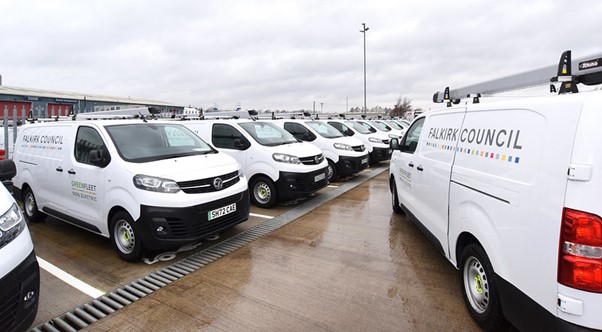
There are approximately 30,000 vehicles in the public sector fleet. Surveys were conducted in 2020, 2022, 2023, and at the end of 2024. View details on Scottish public bodies. The total reported vehicles vary slightly between the years due to some variation in public bodies contributing to the survey in each year. The 2024 survey was expanded to include colleges and universities, which operate a fleet of nearly 800 vehicles.
The public sector operates a diverse range of vehicles from motorbikes and cars to fire appliances, ambulances, and refuse collection vehicles. While zero-emission technology is currently available and widely adopted for lighter vehicles like cars and vans, suitable technological solutions for heavier or more specialised vehicles are not always available.
The Scottish Government has already provided over £80 million of funding through Switched on Fleets and other initiatives to support the decarbonisation of the public sector fleet. This investment has enabled the installation of fleet charging infrastructure for electric vehicles (EVs) and the deployment of zero and ultra-low emission vehicles (ULEVs).
The 2024 public sector fleet survey highlighted encouraging progress, with several public bodies making significant strides in decarbonising their fleets. Twelve organisations have now transitioned between 75% and 100% of their fleet to zero-emission vehicles, including six of these now operating fully zero-emission fleets.
By the end of 2024, over 5,800 zero-emission vehicles (ZEVs) were in operation across the public sector, with survey data indicating that over 19% of the total fleet is made up of ZEVs.
| 2024 | Number of Vehicles | % Zero-emission Vehicles | % of Fleet Zero-emission and ULEV |
|---|---|---|---|
| Blue light Emergency Services | 6911 | 19% | 20% |
| Commissioners & Ombudsman | Not Applicable | Not Applicable | Not Applicable |
| Executive Agencies | 642 | 17% | 18% |
| Executive Non-Departmental Public Bodies | 294 | 37% | 38% |
| Health Bodies | 2984 | 38% | 38% |
| Local Authorities | 15679 | 14% | 14% |
| Non-Ministerial Offices | 25 | 76% | 88% |
| Public Corporations | 27 | 0% | 81% |
| Colleges and Universities | 796 | 24% | 26% |
| Private Companies that provide fleet services | 349 | 8% | 8% |
| Scottish Government | 187 | 27% | 82% |
| Other significant national bodies | 2015 | 29% | 30% |
| Total | 29909 | 19% | 20% |
| % of Zero-emission Vehicles | 2020 | 2022 | 2023 | 2024 |
|---|---|---|---|---|
| Ambulance | 0% | 0% | 0% | 0% |
| Bus-coach | 0% | 1% | 3% | 0% |
| Bus-minibus | 0% | 1% | 3% | 0% |
| Car | 11% | 26% | 39% | 36% |
| Fire-fighting-vehicle | 0% | 0% | 0% | 0% |
| Gritter | 4% | 0% | 0% | 0% |
| HGV | 0% | 0% | 0% | 0% |
| RCV | 0% | 1% | 1% | 2% |
| Van under 3.5 | 4% | 8% | 14% | 17% |
Progress despite some significant challenges
The Scottish Government welcomes the progress made to decarbonise public sector fleets despite some very significant challenges, including the disruption to vehicle supply chains as a result of Brexit, the COVID-19 pandemic, and the war in Ukraine.
In addition, the upfront cost of many ZEVs remains significantly higher than internal combustion engine (ICE) equivalents. Despite these challenges, the Scottish Government remains committed to working with the public sector, supporting and enabling Scotland’s public bodies to continue leading fleet decarbonisation from the front.
What next?
Over the past year, Transport Scotland officials have been working with the public sector to develop an Action Plan that identifies key opportunities and actions to continue to progress Public Sector fleet decarbonisation. The Action Plan reflects the current fiscal and operational environment and takes into account the cost and availability of relevant technologies. This Action Plan is expected to be published in 2026.
The 2025 survey of the public sector fleet is currently underway and following analysis, the findings will be published in summer of 2026.