Investing in Our Network
This section provides the following information:
- How our network has been funded over recent years
- The impact of funding on historical and current condition of our assets
- The scale of our current maintenance backlog
- Future investment levels required for different scenarios
Managing our network to deliver the expected performance requires suitable levels of investment across all our asset classes. Transport Scotland’s funding arrangements are outlined in ‘How Transport Scotland is Funded’, which provide investment into all our life cycle activities.
As with all public spending, the funds available need to be prioritised for the areas which will provide greatest value and mitigate greatest risks, and we do this through our life cycle approach to asset management as outlined in ‘Maintenance’.
Our ongoing approach to developing our asset knowledge through surveys and inspections gives us a clear understanding of historical and current condition of our assets.
We analyse this data to provide insight into the current maintenance backlog for the network, along with the required levels of future investment to deliver certain scenarios such as addressing the backlog, maintaining current condition, minimum budgets required, and the impact of committed budgets.
Historical Funding
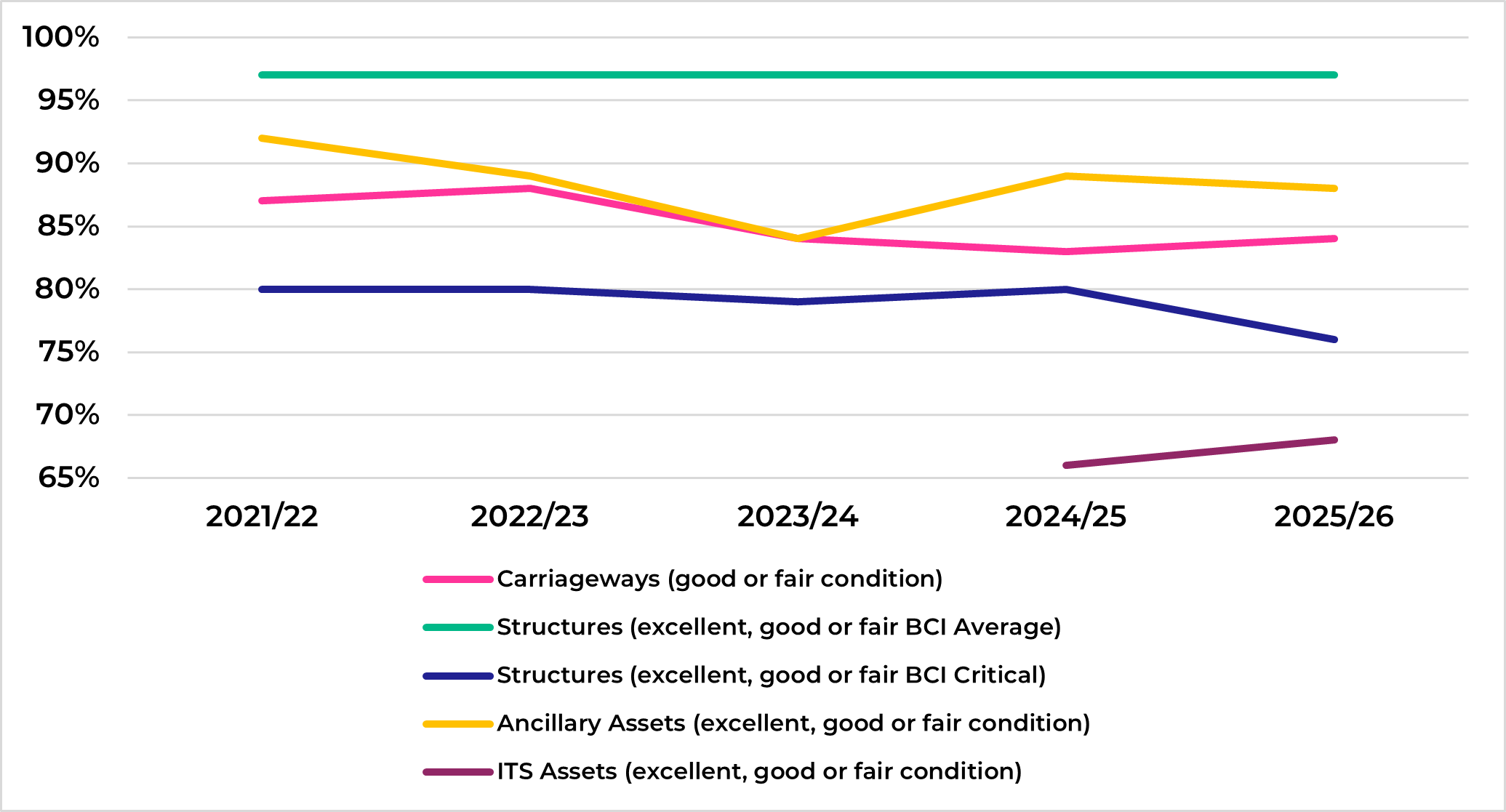
Critical safety, maintenance and improvement funding since 2021/22 is outlined in Figure 5-1 below, with the investment for asset renewals shown as a sub-set of the overall sum. Renewals investment contributes significantly to asset condition improvements. An illustration of the corresponding trends in condition across asset classes is shown in Figure 5-2.
For the data in ‘Investing in Our Network’:
- Percentages shown in the charts may not total 100% due to rounding and differences in the way asset condition categories are defined in source data;
- Formalised data collection and aggregation on ITS assets have been developing in line with our information improvement plans. Historical ITS data (pre-2024) is not available.

Current State of Our Assets
The data from our range of inspections and surveys allows us to understand the condition of our assets, which is vital to managing the network and delivering a safe and sustainable service to our customers.
Carriageway Condition
Structural condition provides an indication of road strength (ability to carry traffic loads) and is measured using the industry standard method of Road Condition Index (RCI). RCI takes account of both the surface and structural (full depth) condition of each individual road type and is categorised using a three-point condition banding; ‘good’, ‘fair’ or ‘poor’.
Further detail on RCI and its categories can be found in Appendix A.
The condition of our carriageway assets is presented in Figure 5-3, with 84% of trunk road carriageways, approximately 7,300 lane-km, currently in ‘good’ or ‘fair’ structural condition which means they do not currently require structural maintenance.

An annual survey of the network also measures the skid resistance of road surfaces, with 87% of trunk road carriageways reporting skid resistance above the required investigatory level. Where the recorded value is lower than the investigatory level, this does not in itself mean that the road surface is deficient, sub-standard or unsafe. It is merely a trigger for a more detailed investigation.
Structures Condition
Transport Scotland has adopted the Bridge Condition Index (BCI) condition standard, which is used by the majority of structures owners in the UK, and calculated from General and Principal Inspection data. Two Bridge Condition Index (BCI) indicators are calculated for each structure. These are defined as:
- BCI Average is the average condition score of all elements of the structure
- BCI Critical is the condition score of the load bearing element which is in worst condition
The BCI values are categorised using a five-point condition banding, ‘excellent’, ‘good’, ‘fair’, ‘poor’ or ‘very poor’. Further detail on BCI indicators and associated categories can be found in Appendix B.
Current indicators for structures assets, as shown in Figure 5-4 indicate that the majority of trunk road structures (97%) have a BCI Average rating of ‘excellent’, ‘good’ or ‘fair’. Additionally, 76% of trunk road structures currently have a BCI Critical rating of ‘excellent’, ‘good’ or ‘fair’.

Ancillary Assets Condition
The condition of our ancillary assets is assessed during regular inspections and surveys, and recorded as being in one of five condition bands: ‘excellent’, ‘good’, ‘fair’, ‘poor’, or ‘very poor’. Further detail on ancillary asset condition and its categories can be found in Appendix C.
The condition of trunk road ancillary assets, aggregated under eight asset groups is presented in Figure 5-5. Currently 98% of lighting assets, 95% of technology assets, 90% of footways, and 90% of road markings are in ‘excellent’, ‘good’ or ‘fair’ condition.

Intelligent Transport Systems Condition
The condition of our ITS assets is assessed during regular inspections and surveys and recorded as being in one of four condition bands: ‘excellent’, ’good’, ‘fair’ or ’poor’. Assets in ‘excellent’ condition are nearly new, whilst assets in ‘poor’ condition may be obsolete. Further detail on ITS asset condition and its categories can be found in Appendix D.
The condition of our ITS assets, aggregated under eight asset groups is presented in Figure 5 6. Currently 81% of comms assets, 77% of power supplies, 73% of data collection assets, and 66% of cables are in ‘excellent’, ‘good’ or ‘fair’ condition.

Maintenance Backlog
The overall maintenance backlog for carriageways, structures, ancillary assets and ITS combined was £3.1 billion in 2025, an increase from £1.2 billion in 2015 as detailed in Figure 5-7. This is due to a combination of deteriorating condition and a recent sharp rise in construction price inflation.

Investment Scenarios
We assess the future performance of assets based on different scenarios utilising a long-term forecast. This can provide visibility of any significant increases or decreases in funding needs and annual work volumes. We regularly identify, develop, and analyse different investment scenarios for each of our major asset classes, including:
- The budget required to address the maintenance backlog over a 10-year period
- The budget required to maintain current condition
- The baseline budget required to meet core commitments
- The impact of committed budgets on future network condition
Based on the budgets and asset management objectives identified from our policy and strategy, Figure 5‑8 summarises each of these scenarios for each asset class.
As noted in ‘How Transport Scotland is Funded’, the allocated budget for critical safety, maintenance and infrastructure, and operations and maintenance is £611 million in 2026/27. Of this budget, £350 million is allocated to the asset renewal budget.
